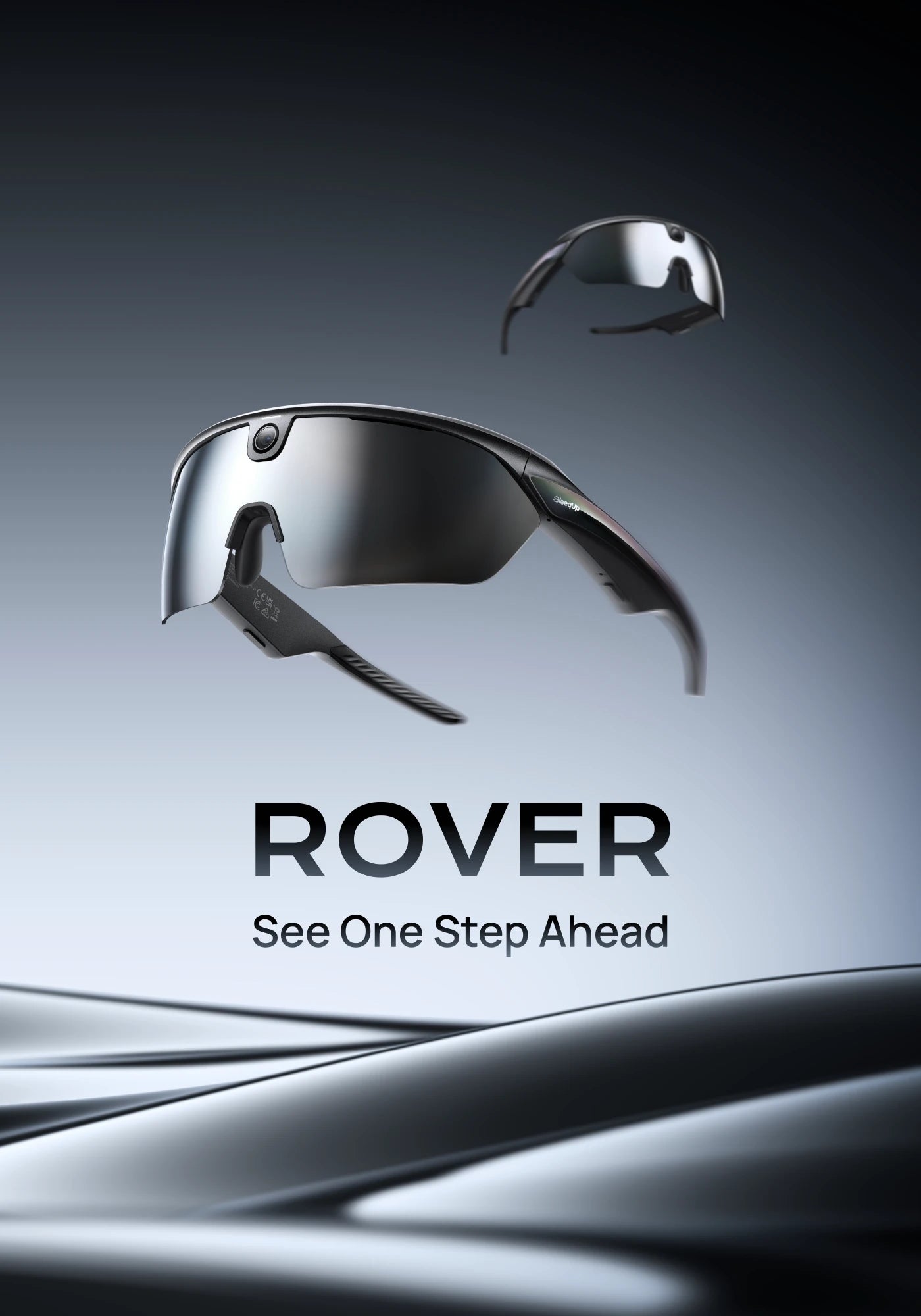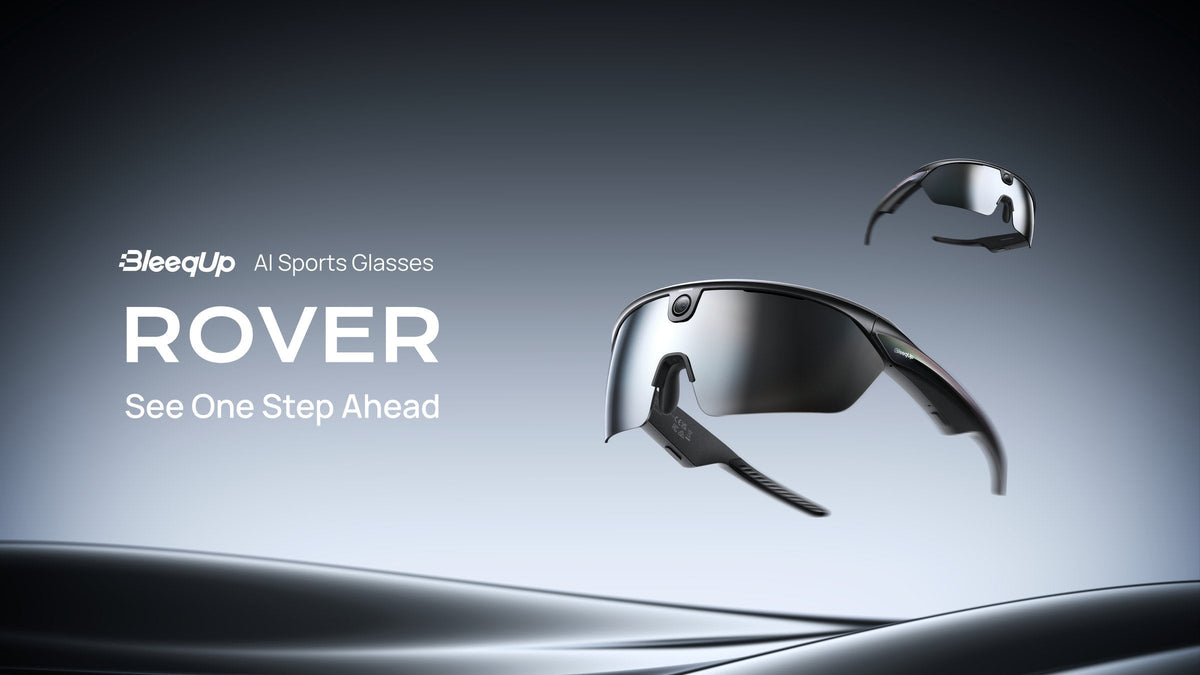
At IFA 2026 in Berlin, our team unveiled Rover — the world's first AI sports companion built into eyewear. Rover is our second-generation pair of AI sports glasses: a full hardware upgrade that uses AI to support training, safety, and content creation at the same time, moving sports eyewear from a recording tool toward an AI sports assistant.
What we brought to IFA 2026
IFA 2026 runs from September 4 to 8 at Messe Berlin, and Rover made its debut on our booth at the show. Visitors could see the glasses in person, try them on, and take a closer look at the 3-level tilt camera at the centre of the hardware design. The photos in this article come from our booth and the show floor in Berlin.
Rover arrives as our second-generation AI sports glasses. The first generation, Ranger, taught us what riders and outdoor athletes actually want from a camera on their face. Rover takes that feedback and pushes the product in three directions at once: capture, safety, and AI support.

Industry-first hardware, built for flexible, pro-grade capture
Rover is built around an industry-first 3-level adjustable camera angle (-10° / 0° / +15°). Instead of one fixed framing, the lens can be fine-tuned to get the best first-person perspective across different riding positions and activity scenarios.
Capture runs through a Sony 16MP sensor: professional-grade 3K 60FPS HDR video and 4K/16MP photos. At just 53 g, the glasses are built to deliver footage quality that rivals dedicated action cameras while staying light on the face.
- Sony 16MP sensor
- 3K 60FPS HDR video and 4K/16MP photos
- 3-level adjustable camera angle: -10° / 0° / +15°
- 53 g frame with 64 GB of storage

An AI sports assistant for training, safety, and creation
Rover isn't limited to recording. AI runs through the whole experience, with three jobs: training support, safety monitoring, and content creation.
Training
During an activity, voice commands wake the AI Sports Assistant for voice Q&A about the session. After each session, users receive a personalized activity summary, along with real-time breathing performance and breathing-based body monitoring data.
Safety
Safety comes first for us. While cycling, Rover automatically detects close passes, collisions, and hard braking, and preserves up to 10 seconds of pre-event footage as video evidence. It also recognises climbs, descents, sharp turns, and changing weather conditions to deliver advance alerts, and uses breathing and heart rate data to issue fatigue and strain prompts so users can respond to safety risks ahead of time.
Creation
After an activity, Rover turns the ride into an AI Roadbook, intelligently combining route, GPS, activity data, and key moments of video into one complete visual story. AI can also detect highlights for one-tap editing, and AI Master Motion turns POV cycling footage into dynamic third-person perspectives.

The idea behind Rover
Our CEO, Derek Wu, framed the launch as a step beyond hardware:
"Rover carries not just the intelligent hardware and technology we've carefully developed and iterated based on feedback from Ranger users, but also BleeqUp's vision to take a step further. We're not just building smarter sports hardware, we want to build a truly intelligent AI-powered decision-making platform for outdoor activities: one that can understand the context, anticipate users' needs, and provide timely, actionable support. BleeqUp will continue to fuse imagery, environmental, and activity data, using AI to help people better understand their own performance, stay aware of their surroundings, and make smarter decisions in every activity."
Derek Wu, CEO of BleeqUp
Availability and pricing
Rover (64 GB) is available on the official online store from 9:00 AM (GMT+2), September 4, 2026.
Official pricing: US$459 / €459 / £409.
About BleeqUp
Founded in 2022, BleeqUp is an AI-powered sports technology brand focused on outdoor experiences. We build AI sports devices designed to understand movement, enhance performance, and provide real-time intelligent support.
As a pioneer in the AI × Sports space, we combine scenario-driven innovation, multimodal sensing, and real-time AI decision-making. By integrating edge AI with lightweight intelligent devices, we are evolving sports technology from simply recording what happens to actively understanding and supporting every move.
Related reading
- BleeqUp Rover is available now
- Why the adjustable camera angle matters in cycling camera glasses
- 3K 60FPS HDR recording: why ride footage looks clearer
- Pre-recording: how Rover keeps the 10 seconds before a cycling moment
- Rover AI sports glasses product page
FAQ
What is BleeqUp Rover?
Rover is our second-generation AI sports glasses and the world's first AI sports companion built into eyewear. It combines a sports camera, an AI Sports Assistant, safety alerts, and AI content tools in one frame.
What camera specs does Rover have?
Rover uses a Sony 16MP sensor and captures 3K 60FPS HDR video and 4K/16MP photos, with an industry-first 3-level adjustable camera angle of -10°, 0°, and +15°. The glasses weigh 53 g, and the launch model ships with 64 GB of storage.
What safety features does Rover provide for cycling?
While cycling, Rover detects close passes, collisions, and hard braking, and preserves up to 10 seconds of pre-event footage. It also recognises climbs, descents, sharp turns, and changing weather conditions for advance alerts, and uses breathing and heart rate data for fatigue and strain prompts.
How much does Rover cost, and where can I buy it?
Official pricing is US$459 / €459 / £409, and Rover (64 GB) is available from the official BleeqUp online store.