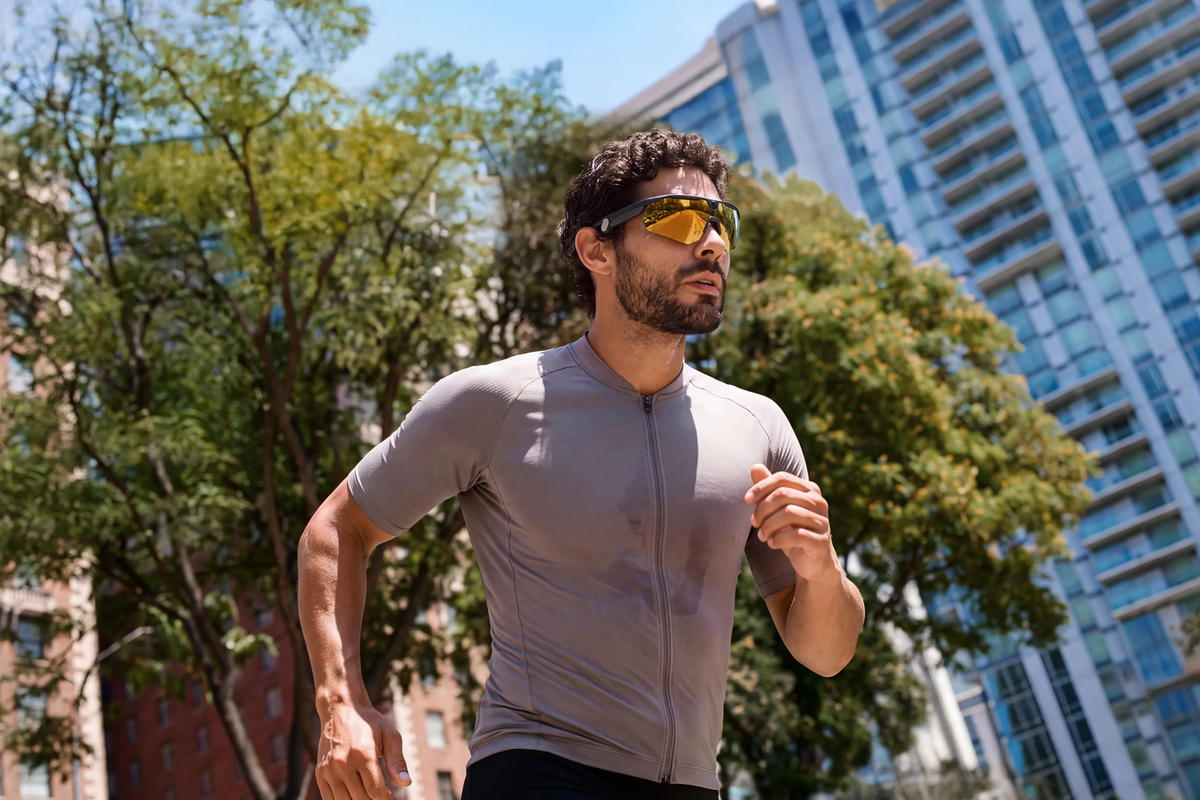
Urban
Running in a city is not trail running with worse scenery. The constraints are different — crossings stop you every few hundred metres, the surface changes constantly, and the traffic that makes it interesting is also what makes it dangerous.
Anyone who moves from a park to a city centre discovers the same thing within a kilometre: the running is constantly interrupted. Crossing a road, waiting at a light, stepping around scaffolding, changing surface from asphalt to paving to cobble.
Those interruptions are the discipline. A good city route is not the one with the most kilometres — it is the one with the fewest forced stops per kilometre, and it is entirely possible to build.
Why city routes are worse than they look
A map shows distance and a road. It does not show any of the things that determine whether a route is runnable.
Signalised crossings set a hard rhythm. Every set of lights you have to wait at is a 40–60 second stop. Four of them in a five-kilometre loop is a meaningful fraction of the run spent standing still, and no pacing plan survives it.
The surface changes constantly. Asphalt, then paving slabs with raised edges, then cobbles, then tactile paving at every crossing. Feet adapt, but calves and ankles take the cumulative load, and a route that alternates surfaces is harder than the same distance on one surface.
Kerbs and steps are interruptions, not obstacles. They break cadence, and repeated cadence breaks are what make city running feel harder than the effort suggests.
The traffic is the point and the hazard. It makes the run interesting and it is what you are exposed to. The safety work is real work.
Building a route that flows
The technique that makes the biggest difference is unglamorous: run the loop in the direction that hits crossings favourably, and accept a longer distance for fewer stops.
Practical rules that hold up:
- Prefer a circuit over an out-and-back. On a loop you can arrange the crossings so the ones you must wait at are near the end, when you are more willing to stop.
- Use underpasses and footbridges where they exist, but check them. Some are better lit and better surfaced than the road crossing; others are the least pleasant hundred metres on the route.
- Run the river or the canal if there is one. Water means a continuous path with no lights, which is the single biggest improvement most city runners can make to their route.
- Use parks as connectors, not destinations. Cutting diagonally through a park between two streets shortens the distance and removes a crossing.
- Check the route at the time you will run it, not at midday. A street that is empty at noon can be impassable at 18:00.
Reverse loops are worth doing deliberately. Running the same route backwards changes which side of the road you are on, which is exactly what determines whether a junction is a flowing turn or a stop.
Handling junctions without losing rhythm
Junction behaviour is where city runners get hurt, and almost all of it comes down to predictability.
Make eye contact, or assume the driver has not seen you. With electric vehicles and tinted screens, the absence of engine noise is not an indicator of awareness. If you cannot see the driver's face, assume they are looking at something else.
Cross behind turning vehicles, not in front of them. A driver turning right is watching the traffic coming from the left, not the pavement they are turning into.
Do not run out from between parked cars. The driver that hits you will have had a fraction of a second. Where there is no gap in vision, there is no crossing worth taking.
Take the crossing at walking pace. Running across a junction removes the redundancy that lets a driver correct. It also puts you at a speed nobody is estimating for.
Assume the first car in a queue will not go, and the second one will. This is the pattern that catches people at multi-lane crossings.

What to carry, and what to leave
The kit list for city running is shorter than the marketing suggests.
Carry identification and a way to pay. A card or a phone with a payment method. The most common city-running emergency is being a long way from home with a problem.
Leave the noise-cancelling. This is not a preference, it is a safety point. Sealed ears in traffic remove the one sense that compensates for what you cannot see. Open-ear audio keeps you aware while still letting you hear something, which is the argument set out in open-ear audio and wind noise.
Wear something that fails at low light. Reflective detail works because of contrast, and most "high-vis" clothing is only effective in daylight where it barely matters. Reflective panels and ankle bands — which move — are what drivers actually register.
Nothing in your hands. A phone in your hand changes your running form and removes an arm from balance. This is the same argument that applies to cameras, covered in running camera glasses. If you want a physical start button rather than a tap on the frame, the Bluetooth Controller mounts on the wrist.
Recording city runs
If you want the footage, the city raises specific problems.
Audio is dominated by traffic. Wind noise and engine noise occupy similar frequencies. A microphone array with wind rejection helps, but the honest expectation is that city footage is about the picture.
Consent matters more in a city. You will film strangers, and in a public street that is generally lawful in most places while still being unwelcome. Filming a person and publishing them are different acts with different consequences, and the common-sense standard is that people going about their day should not end up in your edit by accident.
Consistency of mode beats quality of mode. A city run has a dozen things worth capturing and none of them last long. On BleeqUp Ranger, 1080p30 records without a clip length limit while the 60fps modes cap at one minute and 3K30 lets you choose 1, 3 or 5, and for this kind of running the shorter clips are actively awkward.

The club question
Urban run clubs have grown quickly, and they change the calculus. A group run solves lighting and isolation, and it makes the route someone else's problem.
The trade-off is pace. Group runs tend to settle at the pace of the slowest runner or the fastest conversation, which is usually not the pace you would choose. Going once a week and running your own route the rest of the time is the pattern most people end up with.
If you are choosing between city and trail, the constraints are genuinely different — trail running and hiking covers the other side, and camera glasses while running, hiking and riding compares the three.
FAQ
Is running in the city bad for your knees?
Surface changes and kerbs add load compared with a flat trail or track, but the effect is mostly about cumulative volume and sudden surface switches rather than the city itself. Smooth asphalt is one of the kinder running surfaces.
How do I find a good city running route?
Look for continuity: riverside paths, park connectors, and loops that arrange signalised crossings near the end. Checking the route at the hour you will actually run it matters more than any route-planning app's elevation profile.
Should I run with headphones in the city?
Open-ear audio is the sensible compromise. Sealed or noise-cancelling headphones remove the traffic cues that compensate for what you cannot see, which is a safety decision rather than a matter of taste.
What is the safest time to run in a city?
Typically early morning, when traffic is light and eyes are fresh, though this varies by city and by district. Whatever the hour, the dominant factor is being predictable and visible rather than the clock.
Can I record my city runs?
Yes. Eye-level camera glasses record hands-free without changing your running form, which a handheld phone does not. Expect traffic noise to dominate the audio track.