

After dark
A camera on your face is not what makes a night ride safer, and pretending otherwise is how people end up overconfident in the dark. But there is a real role for eye-level footage after sunset, and it starts with understanding why the sensor is working against you.
Night riding is three separate problems wearing one name, and conflating them is why night kit lists are so long and so unhelpful. You need to be seen by others, you need to see the road yourself, and — if you are the sort of person reading this — you would like to record some of it. A camera solves none of the first two and only partly solves the third.
Getting that ordering right is most of the article. The rest is about why a small sensor struggles in the dark and what settings give it the best chance.

Be seen, see, record — in that order
Being seen is about reflectives, a rear light, and having something visible from the front at eye height. Glasses help here indirectly, and only in one specific way: a clear or photochromic lens rather than a dark tint, so your eyes are visible to a driver looking for eye contact at a junction. A tinted shield at night is a bad idea for reasons that have nothing to do with cameras.
Seeing is a lighting problem. No camera, and no lens, substitutes for a light with enough output and the right beam pattern. What a lens can do is avoid making it worse: clear or light-tinted shields, no polarisation that kills the contrast of wet tarmac under sodium lamps, and a frame that does not sit so low that it catches the top of your own beam.
Recording is where the camera comes in, and it is genuinely useful — provided you accept the physics.

Why small sensors struggle after dark
Three constraints, all of them physical.
Aperture. A pair of glasses has room for a lens roughly the size of a fingertip. There is no space for the fast glass a dedicated action camera or a phone uses, so the sensor receives less light per unit time, and there is no software trick that creates photons.
Pixel size. This is the trade nobody mentions when selling resolution. For a given sensor area, more pixels means smaller pixels, and smaller pixels collect less light each. A high-resolution sensor behind a small aperture in a dark street can be worse than a 1080p one in the same frame, because each pixel is working with less signal.
Processing budget. Noise reduction and brightening have to happen fast enough to keep up with thirty or sixty frames per second on a battery that also has to last an hour. A phone can spend a second per frame on computational night mode; a pair of glasses recording video cannot.
The result is that night footage from camera glasses is noisy, low in contrast, and much softer than the same product's daytime output. That is not a defect to be fixed by a firmware update. It is the category's boundary.
What night mode actually does
"Night mode" in this category is usually a combination of three things: a slower effective shutter (more light per frame, more motion blur), a higher ISO ceiling (more signal, more noise), and different tone-mapping (lifting shadows, protecting highlights).
That combination buys you something real: footage that is visible rather than black. What it does not buy you is clean footage. The trade is always the same — brighter and noisier, or darker and cleaner — and the useful question is which end of that trade you want.
For most riders the answer is "brighter", because the alternative is unusable. But it is worth knowing that you are choosing noise over darkness rather than choosing quality.
One thing to check before you rely on it: a faster frame rate makes low light worse, not better. Sixty frames per second halves the exposure time available per frame, so 3K60 at night is noisier than 3K30 or 1080p30. If the footage matters more than the smoothness, drop the frame rate when the light goes.
The settings that give you a chance
A short, practical list, in the order they matter.
Drop to 1080p30 or 3K30 at night. More light per frame, less noise, and — at 1080p30 — no clip limit at all, so the recording does not stop every minute while you are riding in the dark.
Use the HDR/night mode if the product has one, and check what it does to motion. HDR at night is a mixed blessing: it protects the bright pools of light and lifts the shadows, which is usually what you want on a street, but it can smear moving lights into trails.
Record what is lit. The camera cannot light the world. It gets usable footage where there is a street lamp, a shop window, a car headlight or another rider's light. It gets almost nothing on an unlit country lane. Plan the clips around the lit sections rather than expecting the whole ride to be filmable.
Accept the clip limits. On this hardware 3K30 records in one, three or five-minute clips and 1080p60 and 3K60 are fixed at one minute. In the dark, a sixty-file ride is fine, because you were not going to edit an hour of unlit footage anyway.

What night footage is genuinely good for
Be specific, because the general claim ("capture your ride") is not why anyone keeps a camera on after dark.
Evidence. The most common reason riders want footage at night is not highlights, it is insurance: what the junction looked like, when the car pulled out, how far ahead the light was visible. For that purpose, noisy footage is entirely sufficient. Detail matters less than the sequence of events and the timestamp.
Route documentation. A commute recorded at eye level is a record of what the road is actually like in the dark — where the lighting stops, which corners are blind, where the surface breaks up. That is useful for planning a different, safer route, and it is something no night-riding kit list tells you.
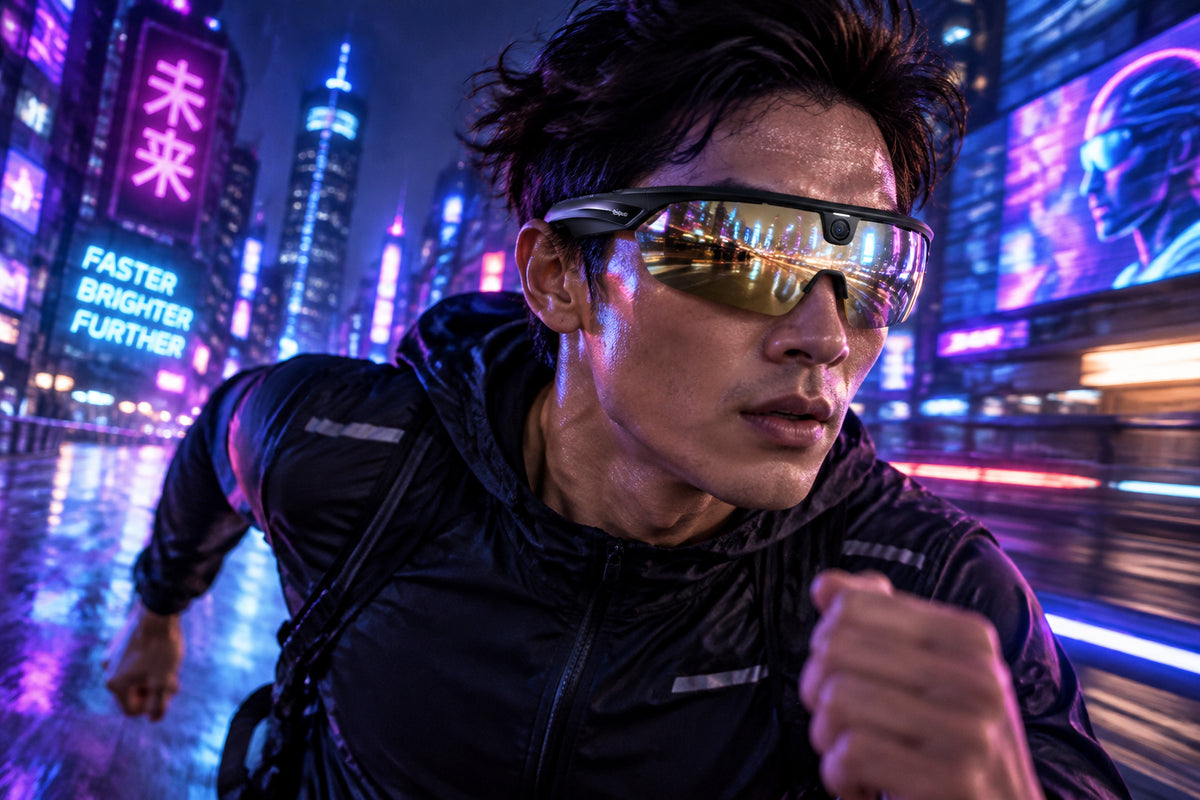
The lit sections. City rides at night have genuinely beautiful stretches: wet asphalt under sodium and LED, shop fronts, bridges. Those clips are worth keeping, and they are also the ones the sensor handles best because there is light to work with.
Audio, surprisingly. Riding at night is quiet, and open-ear audio is how you hear a car approaching from behind before you see it. That is a safety argument for the audio in camera glasses rather than for the camera, and it is a real one.
What does not work, and should not be sold to you
Night vision claims. A small sensor behind a small aperture does not have night vision. If a listing claims to record clearly in complete darkness, it is either describing infrared (which produces monochrome footage at a distance of a few metres) or it is overstating.
Camera as safety device. A camera on your face does not make you visible to a driver, does not warn you about a vehicle, and does not brake. On this hardware there is hazard detection that flags riding situations, and it operates in a cycling context — it is a capture feature, not a safety system.
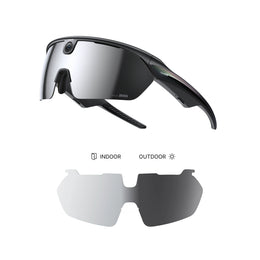
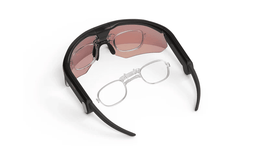
Tinted shields after dark. A dark tint at night reduces the light reaching your eyes, which is the opposite of what the conditions call for. A clear or photochromic shield, or a lens you can swap, is the right answer.

A night kit that makes sense
If the three jobs are being seen, seeing and recording, the kit follows:
- A front light with a proper beam pattern, mounted so it does not blind oncoming traffic, and bright enough for the speed you ride.
- A rear light, ideally with a varying pattern — a static rear light is harder to judge distance on than a moving one.
- Reflective material at ankle or knee height, where it moves. Motion is what the eye and the driver's attention catch.
- A clear or photochromic lens, so your eyes are visible and you can see.
- Camera glasses, for the record, set to 1080p30 or 3K30 with night mode on, and understood as documentation rather than cinematography. The recording glasses buying guide covers how to compare the sensor side, and the rain piece covers the wet-road half of the same problem.
If you are weighing whether the AI layer is worth it specifically for night riding, the honest position is that its value is the same as in daylight — capture assurance and a ride record — rather than any low-light advantage. The product page lists the modes and the night mode, and the 3K60 HDR piece explains what dynamic range does to a frame with a bright light source in it.
FAQ
Can camera glasses record in the dark?
They record, but the quality drops sharply. A small sensor behind a small aperture cannot gather much light, so night footage is noisy and soft. A night mode lifts the brightness, which makes footage visible rather than good. Lit streets work; unlit lanes produce almost nothing usable.
Do I need a light as well as camera glasses?
Yes. Camera glasses do not emit light and cannot replace a front light. They also do not make you more visible to traffic. Night riding needs a light for you to see, reflectives for others to see you, and a camera only if you want a record.
What is the best setting for night recording?
Lower resolution and lower frame rate, because both give each frame more exposure time. 1080p30 or 3K30 with night mode enabled produces the most usable result. At 1080p30 you also avoid the one-minute clip limit, which matters when a ride is long and dark.
Do tinted lenses work at night?
No. A dark tint reduces the light reaching your eyes, which is the opposite of what you need after dark. Use a clear or photochromic lens, or swap the shield before the ride. Some models let you change lenses; check that before you buy if night riding is a regular habit.
Does the AI hazard detection help at night?
It works in the same cycling context as in daylight, flagging situations worth capturing. It is a capture feature, not a safety system: it does not warn traffic, does not brake and does not make you visible. Treat it as a way to make sure a moment exists on the card.
Is a rear light or a camera more important?
The rear light, by a wide margin. Being seen is the first problem of night riding and no camera addresses it. Once the lights and reflectives are sorted, a camera adds a record of the ride, which is worth having but not worth prioritising over visibility.