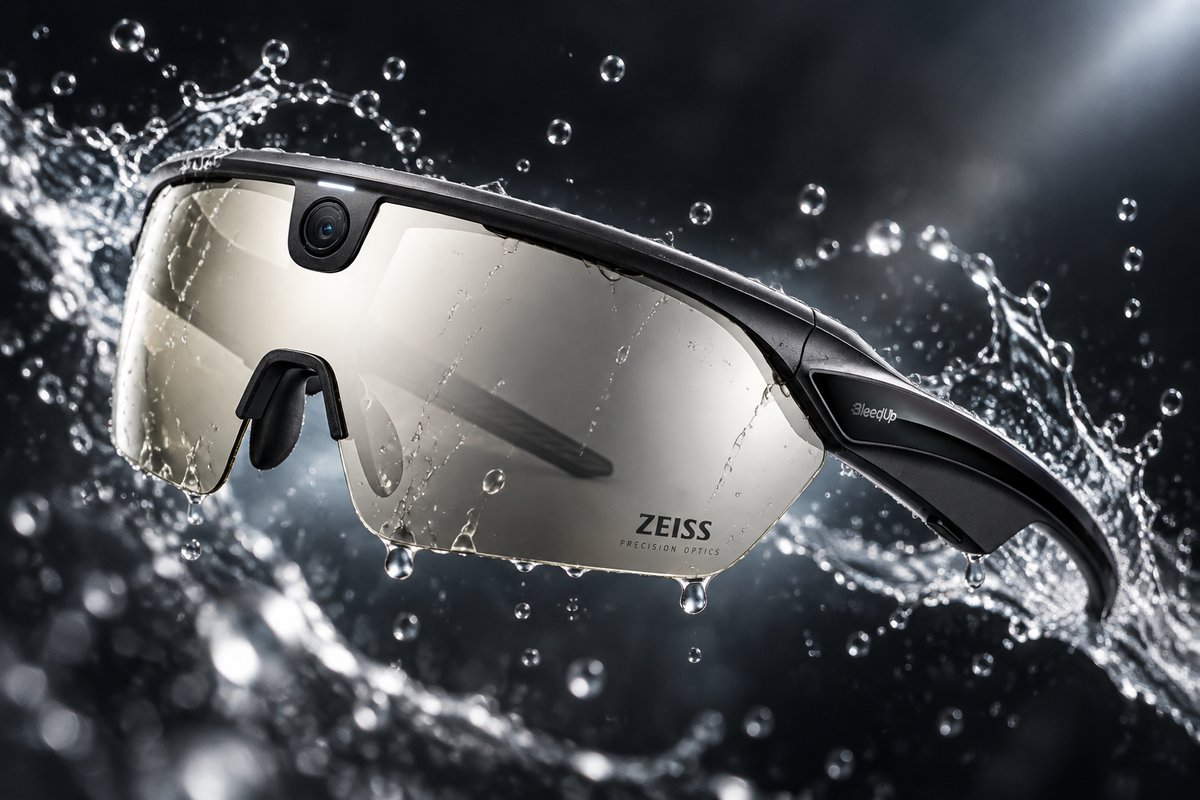
Buying guide
Three different products are sold under the phrase "video recording glasses", and they fail in three different ways. Before comparing resolution or battery figures, it is worth knowing which of the three you are actually shopping for.
The search term is a container. "Video recording glasses" is used for three things that are only loosely related: sunglasses with a covert camera in the bridge, smart glasses that record a few seconds on a button press, and full camera glasses built to shoot continuous footage at eye level. They look similar in a product photo and behave nothing alike.
That matters because the numbers on the box are quoted as if they were comparable. A 1080p clip limit means one thing on a pair designed for continuous recording and something else entirely on a pair designed for ten-second grabs. This article is about reading those numbers correctly, using the hardware on the desk as the worked example rather than the advertisement.

Three products, one search term
Covert camera glasses put a pinhole lens in the frame and a recorder in the temple. They record, but the footage is incidental — no stabilisation worth the name, no field of view worth quoting, and a form factor that prioritises concealment over optics. If the listing leads with recording time in hours and never mentions frame rate, this is what you are looking at.
Smart glasses with a capture button record at a fixed low bitrate for a fixed short duration. The recording is a memory aid, not footage: you are capturing a moment to remember, not a sequence to edit.
Camera glasses proper are built around the camera. They quote a field of view, a frame rate and a bitrate because those are the things the product is for. Recording is the primary job; audio, tint and fit are secondary but still engineered.
The distinction is not marketing hair-splitting. A pair in the third category has to solve problems the first two do not: heat from a continuously running encoder, a battery that survives an hour of writing to flash, a lens that stays clean enough at speed, and stabilisation that works when your head is moving — which is the entire reason you are wearing them.
The four numbers that decide whether you keep wearing them
Every camera glasses listing has dozens of numbers. Four of them decide whether the product ends up on your face or in a drawer.
Weight. Not because light is virtuous, but because nose-bridge pressure accumulates. Fifty-three grams is the figure for the Rover frame; the Ranger is forty-nine. Four grams sounds trivial on a spec sheet and is noticeable after two hours, because it sits on two small pads rather than distributing across your skull. Any camera glasses much above sixty grams will be taken off before the ride ends, and a camera you took off captured nothing.
Field of view. A hundred and twenty degrees is the working figure here. Narrower and you are filming a rectangle of the road ahead while missing everything that made the moment worth recording; wider and the edges distort badly enough that the footage looks like a security camera. The interesting consequence of a wide field of view is that framing becomes almost unnecessary — you point your head and the frame follows.
Frame rate at the resolution you will actually use. This is where listings get slippery. A camera that shoots 3K at thirty frames and 1080p at sixty is not the same product as one that shoots 3K at sixty. Motion is the thing camera glasses exist to capture, and thirty frames per second on a descent or a sprint produces exactly the judder the form factor was supposed to avoid.
Recording time per charge. One hour is the honest number for a continuously recording pair at this size, and it is the number that dictates how the product is used. More on that below, because it is the most consistently misrepresented figure in the category.

Recording time is the number nobody advertises honestly
A 260mAh cell will run the camera for about an hour of continuous recording, the audio for about eight hours, and standby for more than forty. Those three figures describe the same battery, and the only one that matters to someone buying video recording glasses is the first.
The failure mode is not that the number is wrong. It is that the number is quoted without its conditions. "Up to one hour" on a seventy-degree day at 1080p30 is defensible. The same claim at 3K60 in August is a different measurement, because encoding at higher bitrates raises the power draw and warms the body, and a warm battery delivers less. Heat is the hidden variable: a small sealed frame has nowhere to put waste heat, and thermal throttling shows up as a recording that stops early rather than a picture that looks worse.
There is also a second limit that is not about power at all, and it catches people who read only the battery figure.
Clip limits are not the same as recording limits: on this hardware, 1080p30 records until the battery or the card gives out. 3K30 records in clips you can set to one, three or five minutes. 1080p60 and 3K60 are fixed at one minute per clip. A one-hour battery with a one-minute clip limit means sixty separate files.
Sixty files is not a defect. It is a design decision that protects against losing everything when a write fails, and it is why loop recording exists as a separate mode: the camera keeps overwriting the oldest footage so a long session does not simply stop when storage fills. But it changes how you work. You are not recording a ride, you are recording a series of minutes and then joining them.
What 3K60 and HDR change, and what they do not
Resolution is the least interesting of the three. Going from 1080p to 3K adds detail you can crop into; it does not make a shaky frame watchable and it does not fix a blown sky.
Frame rate is more interesting than resolution. Sixty frames doubles the temporal information, which is what makes stabilisation possible in the first place — electronic stabilisation works by cropping and re-projecting, and it has twice as much to work with at sixty than at thirty. On a bike, that is the difference between footage you would post and footage you delete.
HDR is the one that surprises people, and it matters more than either. Camera glasses almost always have a bright sky above the horizon and a dark road below it. A sensor without high dynamic range has to choose, and it chooses the sky, which is why so much helmet-camera footage has a beautifully exposed cloud and a black road. HDR keeps both. On a descent at golden hour, that is not a refinement — it is the difference between usable and not.
What none of it fixes: low light. A small sensor with a small aperture in a frame that cannot take a fast lens will be noisy indoors and marginal at dusk. No amount of processing turns a phone-sized sensor into something that shoots clean footage at night, and any listing claiming otherwise is describing a different product.
Where the footage comes from: eye line versus mount
The case for camera glasses is not that they take better pictures than an action camera. By most measurements they do not. The case is positional.
A handlebar or helmet mount records where the bike is pointing. Camera glasses record where you are looking, which is frequently not the same direction and is almost always the more informative one: the gap you are aiming for, the rider you are checking on, the view you turned your head to see. A mount also has to be aimed, checked and re-aimed; a camera in the brow needs no setup beyond wearing the glasses.
The cost of that position is stability. A mount is rigid relative to the bike; your head is not rigid relative to anything. Which is why electronic stabilisation is not a bonus feature on camera glasses but the enabling technology, and why the frame-rate argument above matters more than the resolution argument.
There is a third position worth naming because it is the reason many people stop using their camera glasses: a camera on your face changes where you look. Once you know you are recording, you start composing, and composing while riding is a bad idea. The fix is pre-recording — a rolling buffer that keeps the last stretch of footage and saves it when something happens — so you are not deciding to record at the moment you should be deciding to brake.

Storage, transfer and the workflow nobody plans for
Two storage tiers are usual: thirty-two and sixty-four gigabytes. At 1080p30, thirty-two gigabytes is roughly four and a half to five and a half hours of footage, which sounds like more than enough until you count the clips you never delete.
Three practical notes.
Clips are files, and files fill storage faster at higher bitrates. The same minute costs more at 3K60 than at 1080p30. If you record at the top setting, plan on roughly half the runtime per gigabyte.
Transfer is the bottleneck, not recording. Getting footage off the glasses and onto a phone is the step that decides whether you ever edit anything. Check how the transfer works before you buy, and check whether it needs a network the glasses can actually see — a captive-portal wifi network will stall a transfer in ways that look like a broken device.
Editing is where the value is realised. An hour of raw footage is a chore. The useful workflow is to record continuously, let the camera or the app mark the moments worth keeping, and edit from those. That is the argument for AI highlight detection and one-tap editing in this category: not that the AI is clever, but that it saves you from scrubbing an hour of video on a phone screen.
What to check before you buy
A short list that eliminates most bad purchases:
- The clip limit at your preferred setting, not the headline recording time. If you plan to shoot 3K60, you are shooting one-minute clips.
- The frame rate at the resolution you will use. 3K30 and 3K60 are different products.
- Whether the top resolution is shipping or only announced. If a listing leads with a number it does not ship today, ask for the release date. An undated capability is not a capability.
- The ingress rating. IP65 covers dust and low-pressure jets — rain and road spray included. Splash resistance alone is not the same promise.
- Whether the lens is swappable. A tinted shield is fine at noon and wrong at dusk; a photochromic or interchangeable lens is the difference between a device for one hour of the day and one for all of it.
- Whether it works without the phone. If recording requires an app connection, the failure mode is a pair of sunglasses.
If you want the same comparison drawn across the whole category rather than one product line, the recording glasses buying guide works through the alternatives, and camera glasses versus an action camera takes the positional argument apart in more detail. The BleeqUp Rover product page carries the full specification if you want to check these numbers against a shipping product.

FAQ
What is the top resolution on video recording glasses?
On BleeqUp hardware the top recording mode is 3K at 60 frames per second with HDR, alongside 3K30, 1080p60 and 1080p30. Resolution alone tells you little: the frame rate at that resolution is what decides whether fast movement stays readable, and 3K60 is the setting this class of hardware is built around.
How long can video recording glasses actually record?
About one hour of continuous recording on this class of hardware, and that one hour is shared with every other moving part: encoding at a higher frame rate draws more power, warm batteries deliver less, and high or low temperatures both shorten the figure. The published number is a best case measured under good conditions.
Why do recording glasses split video into short clips?
Because a single hour-long file is fragile and awkward. Fixed one-minute clips at 60fps, or selectable one, three and five-minute clips at 3K30, mean a write failure costs one clip rather than the session. Loop recording exists for the cases where you want continuous capture and can accept the oldest footage being overwritten.
Do video recording glasses work at night?
Poorly, and it is worth being blunt about it. A small sensor behind a small aperture cannot gather enough light, so footage is noisy and stabilisation has less to work with. Low-light performance is the category's weakest measurement, and marketing claims about night modes should be verified on real footage before you rely on them.
Can I wear video recording glasses with prescription lenses?
On some models, yes — through a prescription insert that sits behind the shield lens, rather than by grinding a prescription into the shield itself. Check that the insert is available for your market and that the frame you are buying accepts one, because it changes the internal geometry.