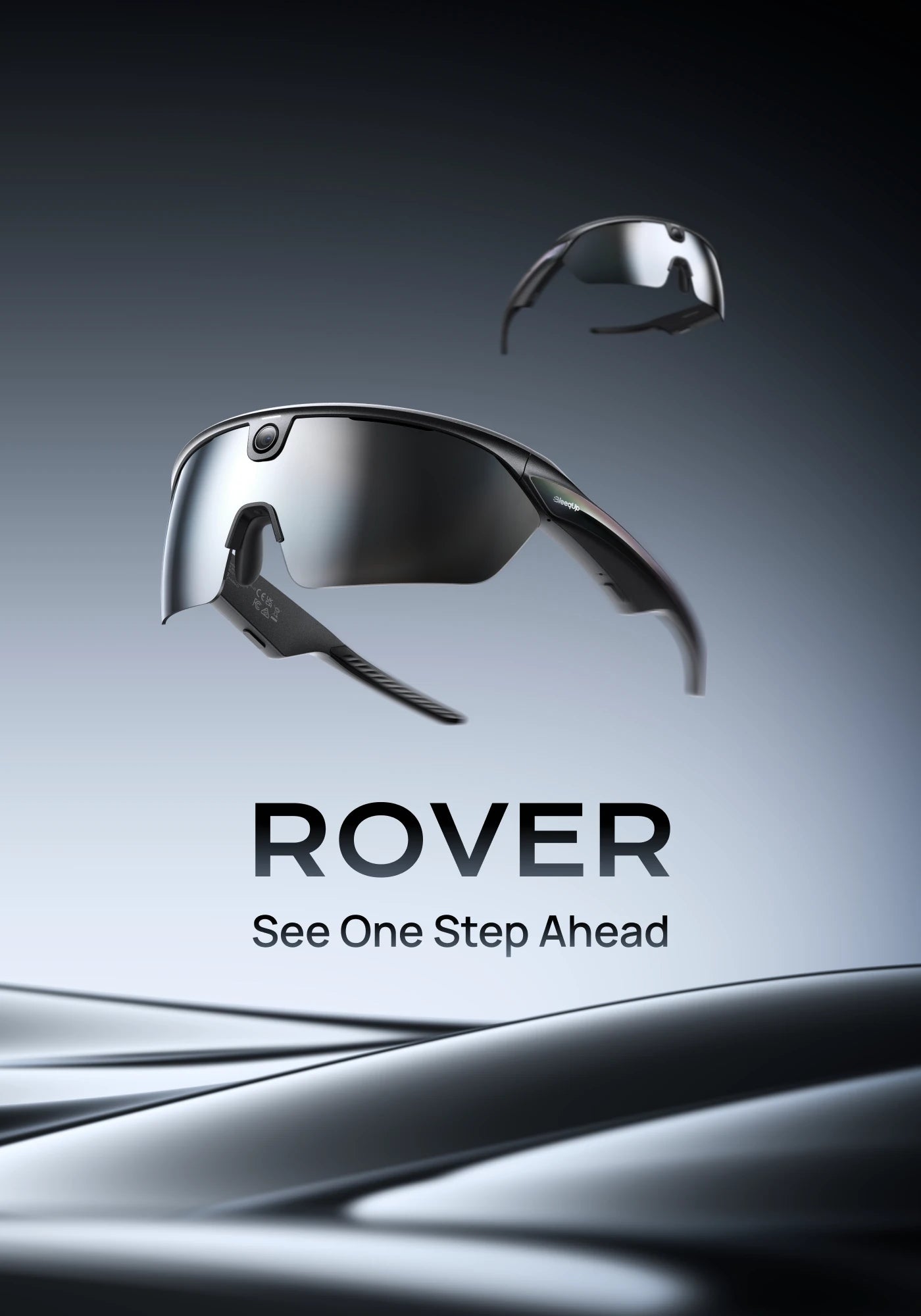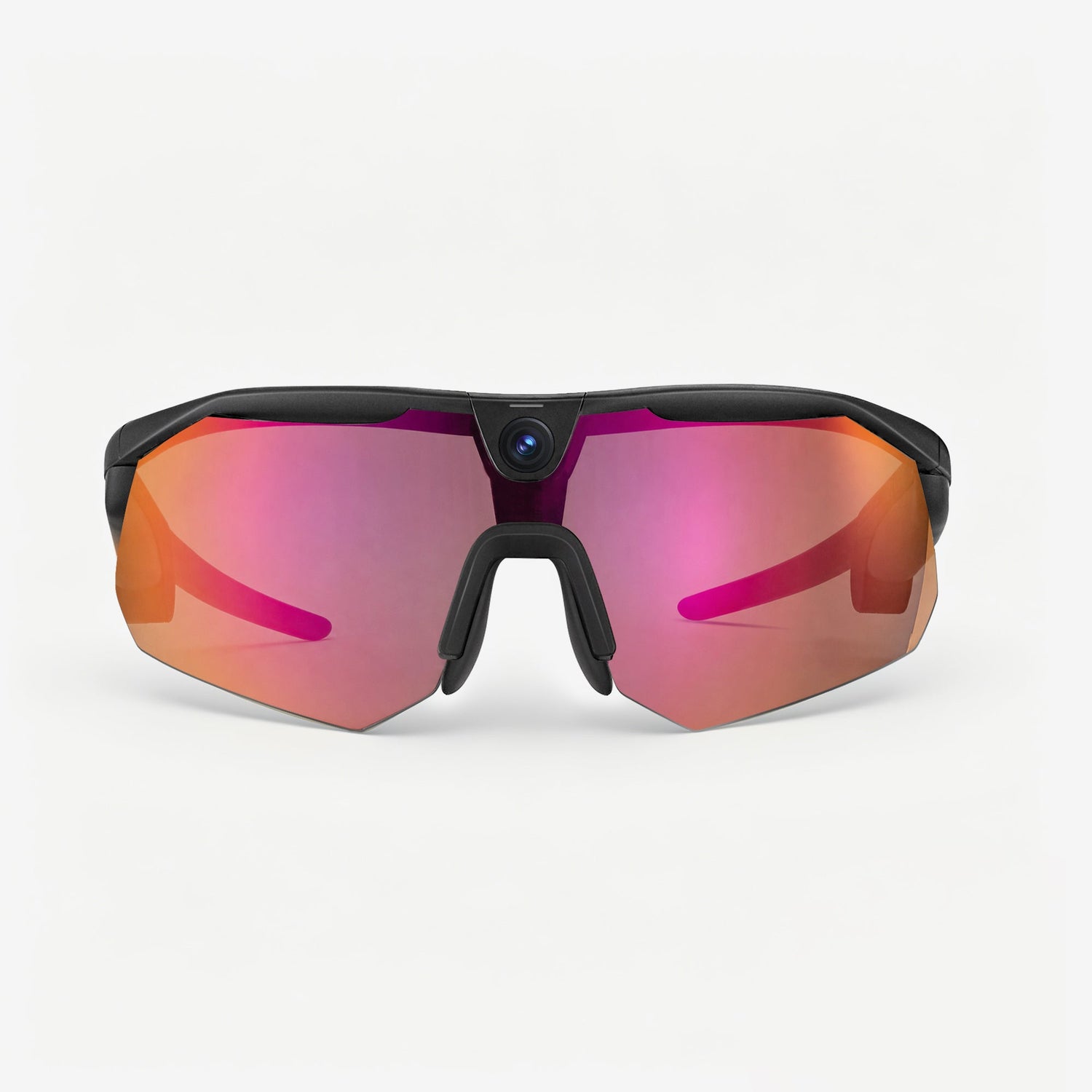
Sports glasses with a camera solve one specific problem. You want to record the ride, run, or climb, but you do not want to stop and fiddle with a mount or a phone. The camera sits in the frame at eye level, and the recording happens while your hands stay on the bars.

The category is still young, which means specs vary a lot between brands. Action camera glasses like these trade a little raw image control for first-person POV that follows your eyes, and that tradeoff is the whole appeal. This guide covers what actually matters when you are comparing a pair, and it maps those points to the BleeqUp Ranger so you can see what a sports-specific option looks like in practice.
What to check before you buy
Five things decide whether sports camera glasses work for you on the road and on the trail.
Fit and weight
You wear these for hours, so a heavy frame or a loose fit will fail before the camera does. Look for a sports frame material like TR90 and a total weight low enough to forget. The Ranger is 49 grams, with a one-size frame and a three-way adjustable nose pad.
Camera and stabilization
Resolution only tells you part of the story. What separates usable footage from shaky mess is electronic image stabilization. The Ranger records 3K at 60fps with a 16MP photo mode across a 120-degree field of view and adds EIS to smooth the bumps.
Audio
If you ride in traffic, you need to hear it. Open-ear speakers beat earbuds because they leave your ears clear. The Ranger uses four open-ear speakers and a five-microphone array with wind-noise reduction effective to about 40 km/h.
Battery
About an hour of continuous video is the Ranger's built-in 260 mAh cell. The Power Plus accessory extends that to roughly five hours. For short commutes the base battery is enough; for long rides you want the extension.
App and workflow
Recording is only half of it. The BleeqUp app imports the footage, handles One-Tap Clip and AI Highlights, and syncs with Strava and Garmin sensors for ride data overlays.
How the Ranger maps to the category
The Ranger is a camera-first sports glass rather than a lifestyle smart glass with a camera tacked on. That shows in the details that matter when you are moving fast.
The IP54 rating means it shrugs off sweat and light rain. The UV400 lens protects your eyes. The storage is 32GB, enough for about four and a half to five and a half hours of video, so the limit is usually the battery rather than the card.
Two camera glasses sit side by side in the lineup. The standard model is $379 with your choice of three styles: black with an orange-red lens, white with a gold lens, or pink purple with a pink-purple lens. The premium tier at $439 swaps in Carl Zeiss co-branded lenses in Zeiss Orange or Zeiss Blue Gold for better optical clarity.
One compatibility note: the higher frame-rate modes, 1080p60, 3K30, and 3K60, currently need an iPhone 14 or later on iOS 18.7.5 or newer. Android support is targeted for mid-2026.
Buying tips
Match the glasses to the sport you actually do most. A commuter cares about open-ear audio and a quick start button. A trail runner cares about stabilization and battery. A road cyclist cares about Strava and sensor pairing. The Ranger covers all three because it was built for cycling first and the other sports ride along.
Skip the glasses that treat the camera as a novelty. If a pair has a camera but no stabilization, no open-ear audio, and no real app, it will produce footage you never watch. The camera has to earn its place in the frame.
FAQ
Are sports glasses with camera worth it?
They are if you want hands-free first-person footage without a helmet mount or a handheld camera. If you already record with an action camera and enjoy the setup, you may not feel the difference. If the setup is the thing stopping you, the glasses remove it.
How long does the battery last?
The Ranger records about an hour of continuous video on its own, and up to five hours with the Power Plus accessory.
Are they water-resistant?
The Ranger is rated IP54, which covers sweat and light rain. It is not meant for swimming or submerging.
Can I wear them with a helmet?
Yes. The frame is designed to sit under a helmet without pushing on it, and the one-size frame with the adjustable nose pad helps the fit stay stable on rough ground.
Do they work with Strava?
Yes. The Ranger has native Strava integration and pairs with Garmin cadence and heart rate sensors.
See the full BleeqUp Ranger AI Sports Camera Glasses lineup and the Zeiss lens options if you want the premium optics.
Related reading: best camera glasses for sports in 2026, what camera glasses are.