Mountain Bike
The choice between goggles and camera glasses is not a taste question. It is a seal question — and the answer changes with the trail, the speed and who is riding in front of you.
Mountain bikers argue about goggles the way road cyclists argue about tyre width — with strong opinions and very little reference to the actual conditions. The reference to keep is simple.
A goggle has a foam gasket that seals the eye socket. That seal does three things: it blocks dust and spray, it keeps a reservoir of warm moist air away from the lens, and it holds a large lens far enough from the eye that peripheral vision is genuinely wide.
A pair of glasses does none of those three things. It vents, so it does not fog the same way. It sits on the nose and temples, so it lets air and grit past the edge. And its lens is small and close.
Both are correct choices. They are correct in different places.
The three conditions where goggles are not optional
You are following another rider at speed. Roost is the single most decisive argument in this whole comparison. A rear tyre throws a plume of grit and mud that a vented frame cannot stop. If you ride in a group, or race, or ride bike park, goggles are the right call regardless of how good the camera is.
It is cold and fast. At 50 km/h downhill in single-digit temperatures, the wind alone will make your eyes stream. A goggle gives you a sealed volume of still air; glasses give you a wind tunnel.
You wear contact lenses. Dry, gritty air and contacts are a bad combination, and the seal is what protects them. This one is not about preference at all.
If all three of those describe your riding, stop here: ride with goggles, and put the camera somewhere else.
The three conditions where glasses win
You are climbing. This is the strongest case and it is almost never mentioned, because climb footage is not dramatic. A climb is sustained effort at low speed with high heat generation, and a sealed goggle on a 30 °C fire road climb fogs, drips and becomes genuinely unpleasant. A vented frame does not.
It is humid and slow. Technical, rooty, low-speed riding in a damp forest is the fog scenario. The reason glasses fog less is not clever coating — it is that air moves across the lens. That advantage disappears the moment you stop, which is worth knowing.
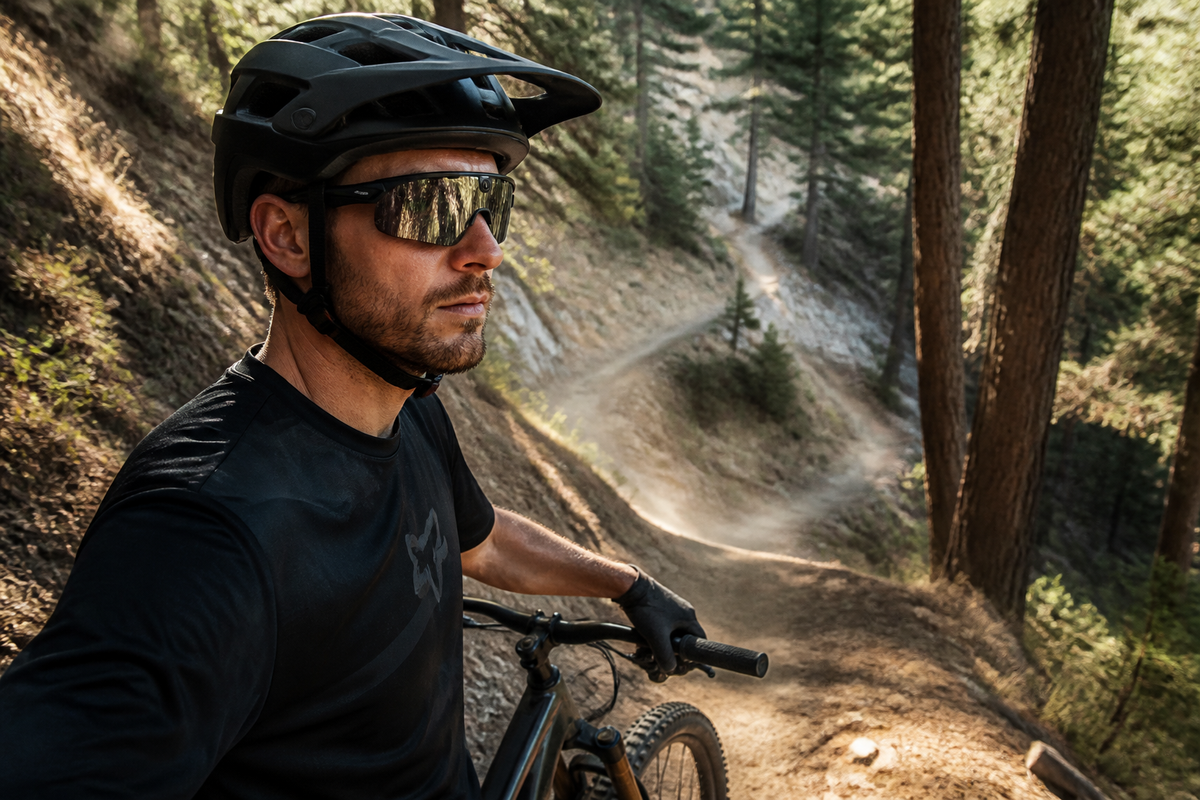
You want to record. This is the difference people underrate. A camera on a goggle is a fairly heavy object bolted to a fairly unstable platform, and a goggle-mounted camera sits high on the face, exactly where the head moves most. A camera integrated into a 53g pair of glasses sits low, close to the eye line, and moves with the head rather than lagging behind it.

Helmet compatibility is the hidden constraint
Half-shell helmets with a visor work with both. Full-face helmets are where it gets awkward: the opening is shaped for a goggle, the strap runs across the goggle frame, and a pair of glasses inside a full-face has very little room at the temple.
If you ride park and you wear a full-face, the honest recommendation is goggles for the descent. Glasses are for the climb, the transfer, and the ride home.
Dust, scratches, and the thing nobody warns you about
A goggle lens is large, replaceable and expensive. A glasses lens is small, often not replaceable, and cheap by comparison — which means riders treat them completely differently.
The realistic damage pattern for camera glasses off-road is not a crash. It is grit on the lens being wiped off with a gloved finger. That is how a lens gets scratched, and a scratched lens is a scratched camera lens too, because the module sits behind the same front element assembly on most of these designs.
Carry a microfibre cloth, use it dry, and do not wipe a dusty lens with a glove. That single habit extends the life of the product more than any case.

Water, mud and what IP65 actually covers
IP65 means dust-tight and protected against low-pressure water jets from any angle. For mountain biking that is a sensible rating: it covers spray, splashes, mud that gets flicked onto the frame, and the rain shower you did not forecast.
It does not cover immersion. If you ride through a stream crossing deep enough to submerge the frame, dry it out before charging and do not assume it is fine.
The camera aperture itself is the part to think about, not the electronics. Water beading on the front element degrades footage long before it threatens the hardware, which is worth remembering when you are choosing whether to keep recording in the rain. Our longer piece on riding in the rain with camera glasses covers that in detail.
A practical rule that settles it
Choose per trail, not per rider:
- Bike park, uplift days, group descents, racing → goggles. Camera on the chin bar or not at all.
- Trail centre climbs, transfers, all-day XC, riding alone on dry singletrack → glasses, and the camera comes for free.
- Wet, cold, fast → goggles.
- Hot, humid, slow → glasses.
Most riders own both and use both on the same day. The mistake is picking one identity and defending it.
Recording settings that suit mountain biking
Rover's clip limits are the same in every sport, and on a mountain bike they interact badly with run length:
| Mode | Per-clip limit |
|---|---|
| 1080p30 | no time limit |
| 3K30 | 1, 3 or 5 minutes per clip (selectable) |
| 1080p60 | 1 minute (fixed) |
| 3K60 | 1 minute (fixed) |
A typical trail centre descent is two to four minutes. 3K30 set to three minutes fits it; 3K60 will split the run at sixty seconds and there is no way to join the fragments back into one clean take without editing.
Stabilisation matters more off-road than on tarmac, because the surface is doing the shaking rather than the rider. Multi-axis electronic stabilisation is not a gimbal and it will not fix a badly shaken frame, but it is the difference between readable and unwatchable on a root section.
Where to go next
For the cross-sport view of when a camera on the face beats a mounted camera, see camera glasses for outdoor sports.
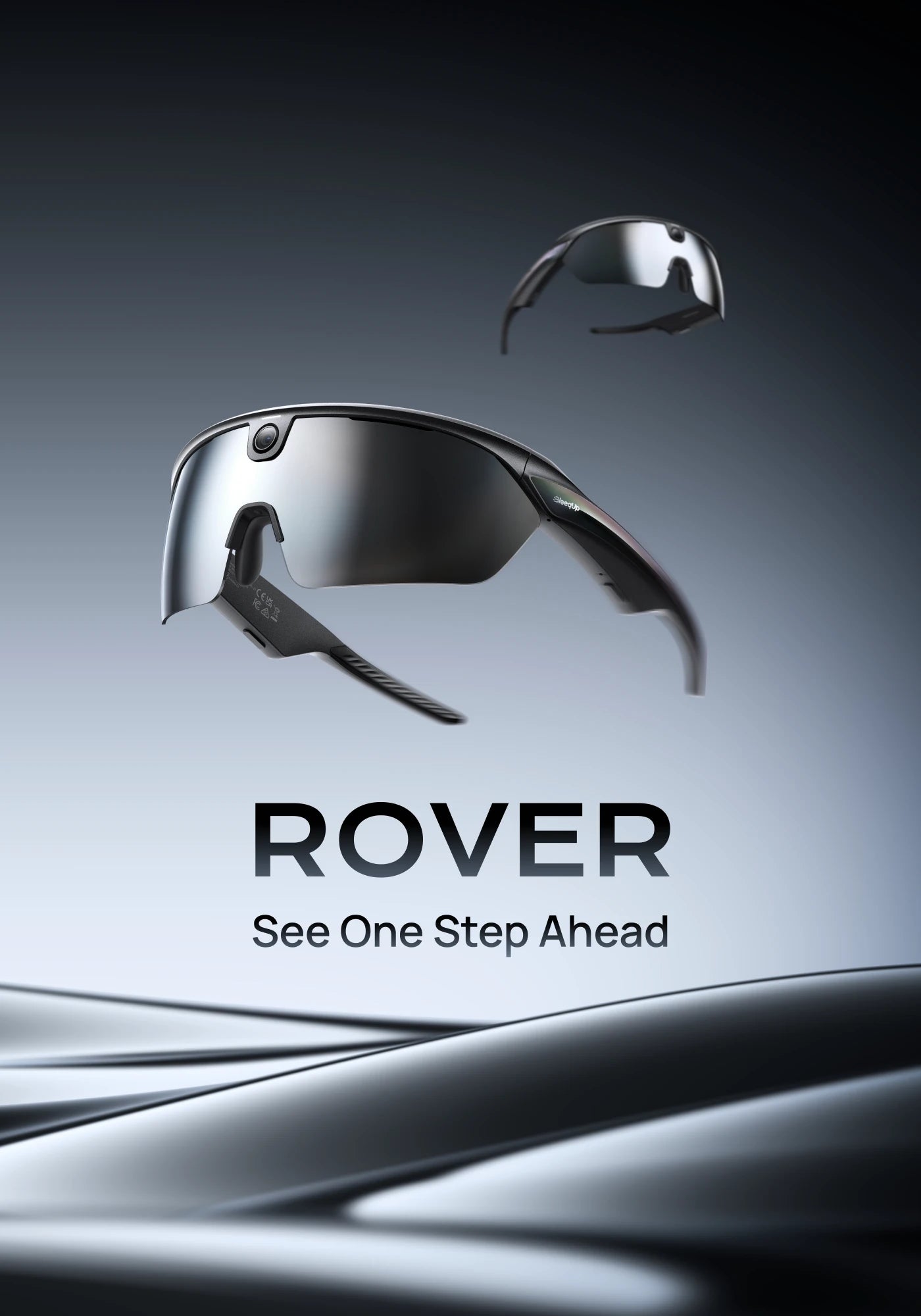
Specifications for Rover — 53g, IP65, 120° field of view, 3K60 HDR, 32GB or 64GB — are on the BleeqUp Rover product page.
FAQ
Can camera glasses replace goggles on a mountain bike?
Only on the trails where goggles were never necessary. Goggles seal against dust, roost and cold wind; camera glasses vent. In bike park, in a group at speed, or in cold weather, goggles are the correct eyewear and a pair of glasses is not a substitute.
Which is better for recording — a camera on goggles or camera glasses?
Camera glasses generally produce steadier footage, because the camera sits low and close to the eye line rather than high on a goggle frame. A goggle-mounted camera also adds weight in front of your face, which is noticeable on long descents.
Do camera glasses fog up on a climb?
Less than a sealed goggle, because air moves across the lens. The advantage comes from ventilation rather than a coating, which means it disappears when you stop moving. On a long, hot climb in still air, expect some fog at the edges.
Are they safe in a crash?
They carry an ANSI Z80.3 everyday impact rating, which is not ANSI Z87.1 industrial protection and is not a sport-impact certification. Treat them as eyewear, not as protective equipment, and expect them to survive ordinary drops rather than impacts.
How much footage fits on 32GB?
Roughly four and a half to five and a half hours at 1080p30. Higher resolutions and frame rates consume storage faster, and loop recording will overwrite the oldest clips as it fills.