On the court
Racquet sports put a hard ball near your eye at close range, which makes this the one category where the eyewear question comes before the camera question. Getting that order right is most of the decision.
Pickleball and tennis have a specific hazard that cycling and running do not: the ball comes at your face. A drive off the paddle at the kitchen line arrives faster than a reflex, and the most common serious injury in the sport is an eye injury.
That reframes the shopping question. It is not "which camera glasses should I wear on court" but "what protects my eye, and does a camera fit into that".

Protection comes first, and the rating is the whole argument
Two standards matter and they are not interchangeable.
ANSI Z87.1 is the occupational eye and face protection standard. It tests high-velocity impact, chemical splash, dust and more, and certified eyewear is marked as such. For racquet sports, this is what protective eyewear is generally tested against.
ANSI Z80.3 is the standard for non-prescription sunglasses. It covers optical quality, UV transmission and basic impact resistance — real, but not an occupational protection standard, and not tested against the high-velocity impact a ball represents.
Rover is rated ANSI Z80.3. It is not Z87.1. That single sentence decides the answer:
- If you play competitively, or you have had an eye injury, or your club or league requires protective eyewear, buy certified Z87.1 protection and wear it.
- If you are playing socially and want sunglasses that record, an everyday-impact shield is honest eyewear for that purpose — provided you understand it is not the same promise.
Any article that blurs this is doing the reader harm, including this one if you skim it. The safety glasses piece goes through the same distinction from a worksite angle.

What the form factor gets right for court sports
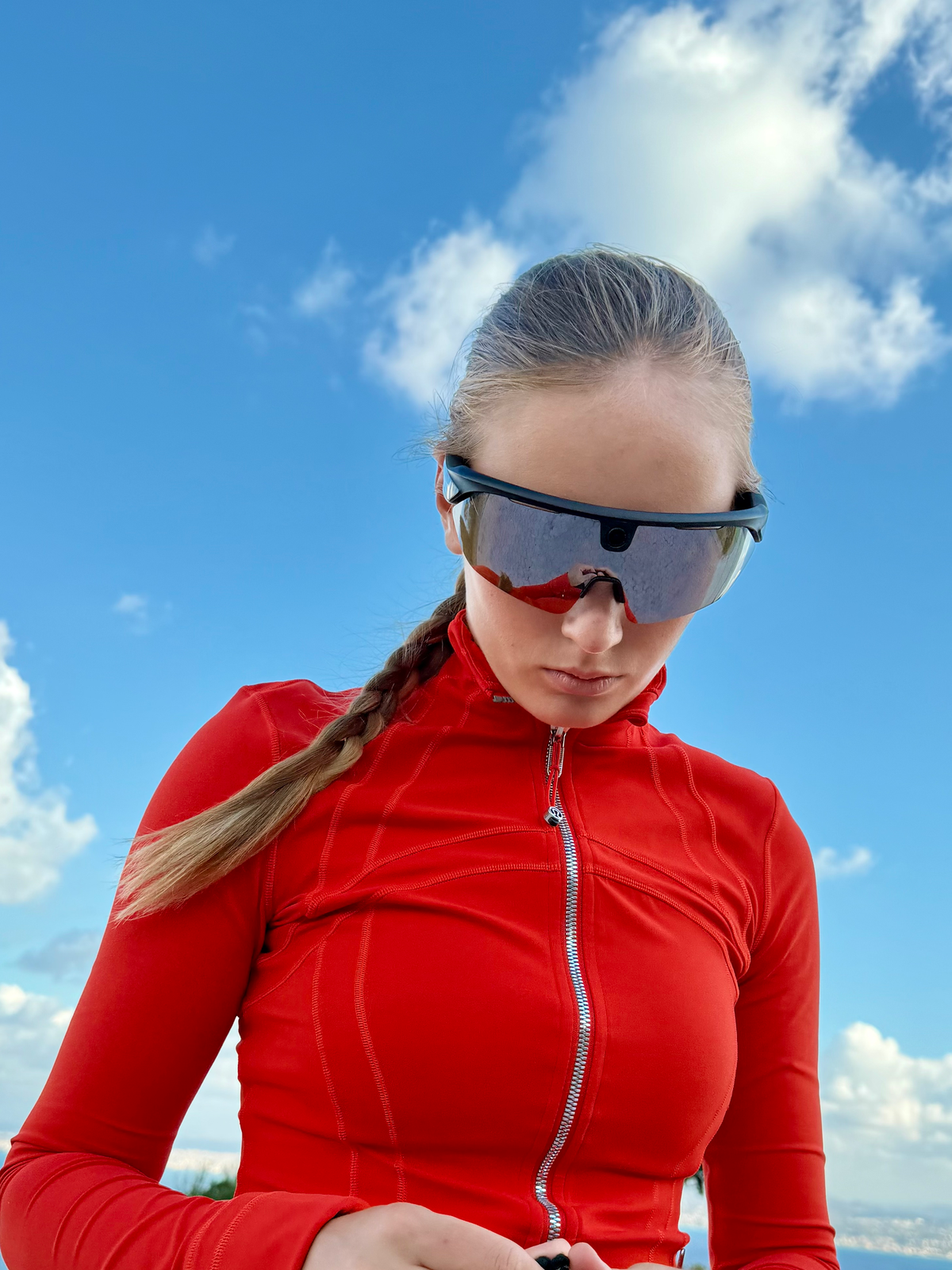
Setting the certification aside, a wraparound sports shield is genuinely well suited to racquet sports.
Peripheral coverage. A ball approaching from the side of your vision is the one you cannot flinch from. A shield that wraps past the temple covers angles a flat-lens frame does not. This is why every serious racquet-sport eyewear looks the way it does.
It stays on when you move. Pickleball involves more lateral movement and sudden direction changes than most sports. A frame that shifts when you lunge is a frame you will adjust mid-rally, which is a distraction at exactly the wrong moment.
UV400. Outdoor courts are bright and the sun is often in your face across the net. Full UVA and UVB blocking is the baseline for any outdoor eyewear and it is what these lenses carry.
Open-ear audio. Courts are social — the ball, the call, your partner. Open-ear directional audio keeps both ears open while a podcast or a call runs, which in-ear headphones cannot do safely on a court where a ball may be called.
The one thing on court that is a genuine camera advantage
Racquet sport is played from the eyes, and the thing players most want to know afterwards is usually not "how did I look" but "where was I looking".
Eye-level footage answers that. On a return of serve, a camera at your eye line records what you were watching when you committed — the toss, the racket face, the bounce. On a volley exchange at the kitchen line, it records how early you picked up the ball. Those are questions a fixed sideline camera cannot answer, because it is not standing where you were.
It is also the honest limit: a camera on your face records your *perception*, not your *technique*.
The thing it cannot do, and why
It will not replace a stroke-analysis camera. Coaching footage for pickleball and tennis is shot from a fixed position — behind the baseline, or side-on to the stroke — and held consistent across a session so that two shots can be compared. A camera on a moving head produces a different frame every time, which is exactly wrong for comparison.
The same logic applies in golf, and the same split applies on a golf course: the fixed tripod angle is the teaching tool, the worn camera is the record.
It will not show you the rally. A 120-degree forward field of view covers what is in front of you. A doubles partner beside you, the ball you chased into the back corner, the opponent you turned to watch — all outside the frame.
It will not survive being hit. An everyday-impact shield is not a face guard. Do not treat any camera glasses as a substitute for a certified protective frame.

Practical setup if you take them to a court
A few things that come from the hardware rather than from theory.
Record at 1080p30 for a session. On this hardware 1080p30 has no clip limit, so an hour of play records as one file rather than sixty one-minute pieces. 3K60 is for a single point or a specific drill you want in better quality — it caps at one minute per clip.
Plan for an hour. Continuous recording runs about one hour on a charge. A social session is two. That is a reason to record selected games rather than everything, which usually produces better footage anyway.
The tilt setting matters more than you would think. Serving and returning involve a head-up posture; a low volley involves head-down. Level is the right default on court. The three-position module adjusts to minus ten or plus fifteen degrees if your natural posture needs it.
Heat is the other limit. An outdoor court in summer is a warm environment for a device that is already writing video continuously. Take the recording in blocks rather than running the camera for the whole session.
Ask before filming anyone. A pickleball court is a social space with four players and often a queue watching. Recording people without asking is the fastest way to end up in an argument about it, and most people say yes if you ask.
Indoor courts are a different problem
Indoor pickleball and indoor tennis are often played under flat, even, artificial light — which is much easier than outdoor sun but dimmer than daylight. Two consequences:
Lens choice changes. A dark tint that is right outdoors is wrong under a gym ceiling. A clear or lightly tinted shield, or a photochromic one, is the correct answer indoors.
Footage is noisier. A small sensor behind a small aperture struggles in gym lighting, and the footage will be softer and grainier than the same camera outdoors at noon. It is usable for review, not for anything you would publish. It is the same small-sensor physics that makes any low-light footage soft.
A quick way to decide
- Competitive play, or any history of eye injury? Certified protective eyewear, always. Add a camera separately if you want one.
- Social play, bright outdoor courts, and you want a record? A UV400 wraparound shield with a camera in the brow is a reasonable single object.
- You want to improve your stroke? A fixed camera plus a coach. No worn camera substitutes for it.
- You want to know where you were looking? This is the one thing eye-level capture does that nothing else does.
If you are comparing camera eyewear across sports rather than specifically for court use, camera glasses for outdoor sports is the overview, and the sports glasses buying guide compares the category on optics and audio. The BleeqUp Rover product page carries the full specification, including the impact rating that this article keeps returning to.
FAQ
Are camera glasses safe for pickleball?
They carry an everyday impact rating — ANSI Z80.3 on this hardware — which is not the same as ANSI Z87.1 protective eyewear. For social play in good light they are honest sunglasses. For competitive play, or if you have had an eye injury, wear certified protective eyewear instead and do not treat camera glasses as a substitute.
Do you need eye protection for pickleball?
Yes. The most common serious pickleball injury is to the eye, from a ball struck at close range off the paddle. Most players wear some form of eyewear; the question is whether it is certified protection or fashion eyewear.
What is the difference between Z80.3 and Z87.1?
Z80.3 is the standard for non-prescription sunglasses — optical quality, UV transmission and basic impact resistance. Z87.1 is the occupational eye and face protection standard, tested against high-velocity impact and other hazards. Only the second is a protection standard for sport.
Can camera glasses help you improve at tennis?
Not for technique. Stroke analysis needs a fixed camera held in the same position across shots so they can be compared. Eye-level footage records what you were looking at, which is a different and narrower kind of insight.
How long can they record a match?
About one hour of continuous recording per charge. A match or a social session usually runs longer, so plan on recording selected games. At 1080p30 there is no clip limit, so a recorded game arrives as a single file.
Do they work indoors?
Yes, but expect dimmer footage. Indoor courts are lit far below daylight, and a small sensor will produce soft, grainy video. Use a clear or lightly tinted lens indoors — a dark outdoor tint is the wrong choice under a gym ceiling.