Eyewear
Most running sunglasses are sold on style and bought on fit, and almost nobody explains that the two things that make a pair stay put are frame width across the temples and how much the arm tapers behind the ear.
There is a specific failure that every runner who wears sunglasses has experienced: the pair that felt fine in a shop has, by kilometre four, migrated down the nose and started bouncing. It is not a fit problem that can be fixed by tightening something. It is geometry, and it is worth understanding before you spend money.
This is about what makes running sunglasses stay on a face, and what lens choices actually do in real conditions.
Why running sunglasses slip
Four forces are acting on a pair of sunglasses while you run, and only one of them is weight.
Downward load. The frame is carried on the bridge of the nose and the mastoid process behind the ear. Every gram matters more than it looks, because the bridge of the nose is a poor shelf: skin moves, and the load has to be redistributed by friction.
Bounce. Vertical acceleration with each step pushes the frame up and lets it fall. A loose fit amplifies this into visible bounce, which is both annoying and damaging to the field of view.
Rotation at the temples. A frame that is wider than the head splays the arms outward, which reduces the contact area behind the ear and lets the frame slide forward.
Sweat. Friction that depends on skin contact degrades when the skin is wet. This is why a pair that is fine in winter is not fine in July.
The consequence: the two dimensions that decide whether sunglasses stay on are the width across the temples and the shape of the arm where it passes behind the ear. Neither is quoted on a spec sheet, which is why buying blind is a gamble.
What actually helps
Arm taper behind the ear. A straight arm slides. An arm that narrows and then hooks gently downward stays, because it is resisting a forward pull rather than relying on friction alone.
Elastic frame material. A frame that can flex — TR90, for example — conforms to the head rather than clamping it or being clamped. Rigid frames have to be either slightly too wide or slightly too narrow, and both are wrong for somebody.
Low weight. Weight is a proxy for how much friction the geometry has to generate. A lighter frame needs less grip to stay in place, which matters most in the last third of a run when you are sweating.
A nose piece with some compliance. A hard bridge on a soft nose is a slip; a compliant one spreads the load.
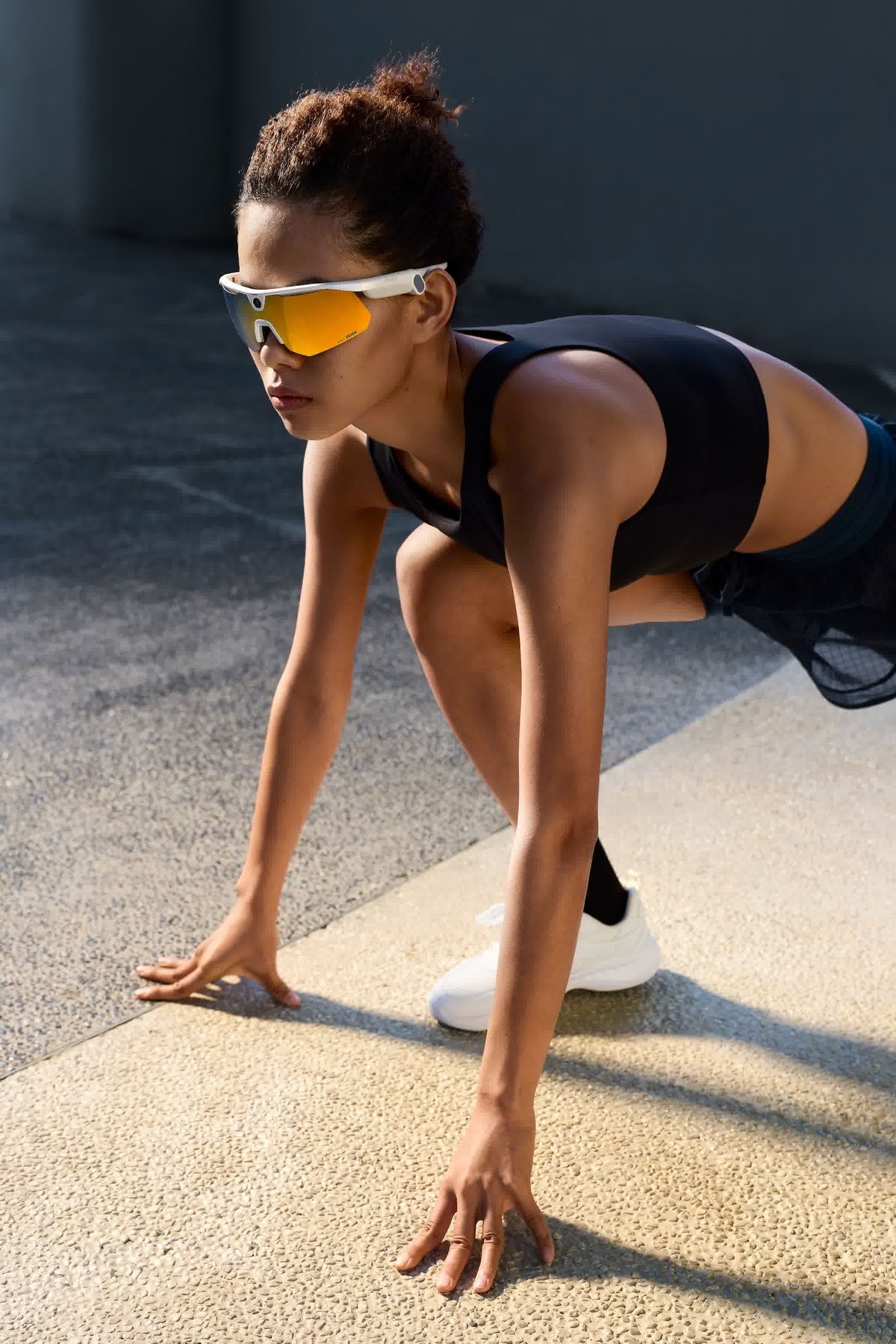
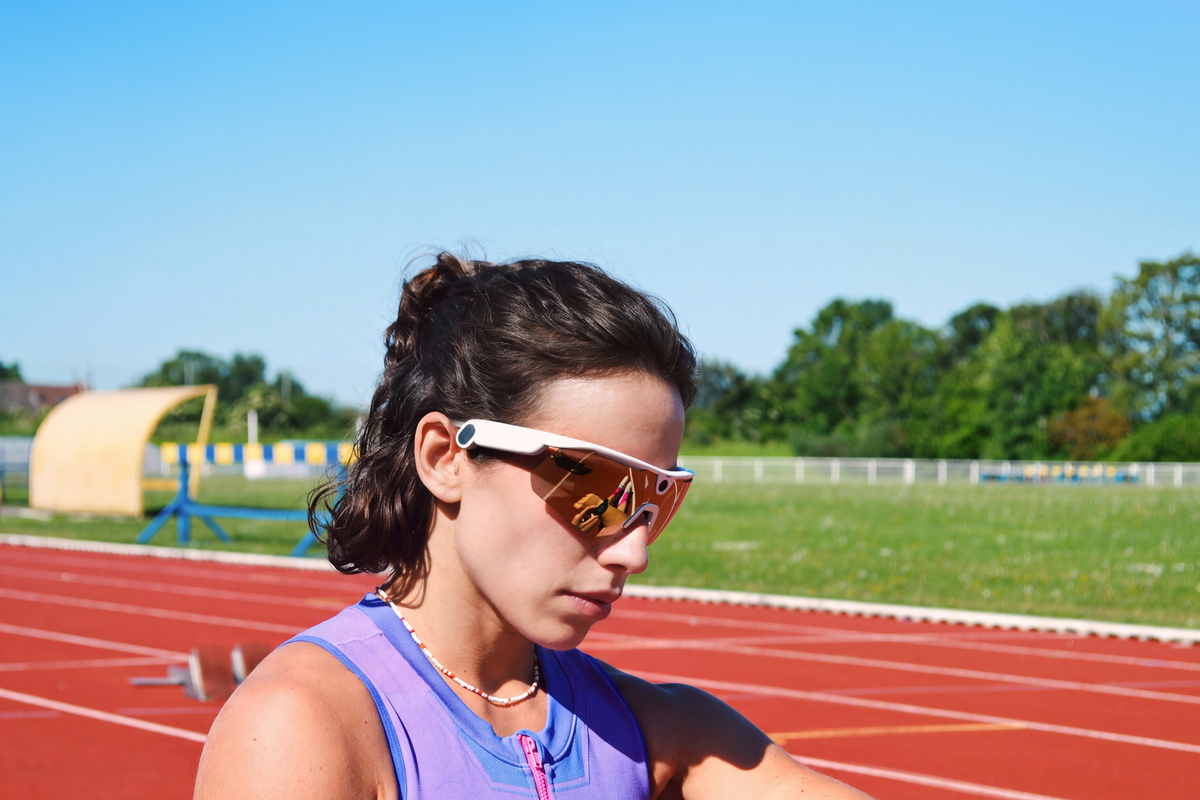
On the spec side, BleeqUp Ranger is 49g with glass, uses a TR90 frame, and is rated UV400 and ANSI Z80.3. The white colourway pairs a white frame with a champagne gold mirrored lens — the Ranger AI Sports Camera Glasses page lists the colours, and if you need correction there is a separate prescription option.

Lens tints, and what they are actually for
Lens colour is treated as a style choice, and it is not. Tint changes how much light reaches your eye and — more importantly — which parts of the spectrum dominate, which changes perceived contrast.
| Tint | What it does | Where it works | Where it does not |
|---|---|---|---|
| Grey | Reduces brightness evenly, minimal colour shift | Bright, high-contrast days | Flat light, where it flattens further |
| Amber / orange | Lifts contrast, makes edges pop | Overcast, woodland, mixed light | Very bright days, where it feels too light |
| Gold / champagne mirrored | Warm contrast with a mirror coating that cuts glare | Bright sun with reflective surfaces | Dim conditions |
| Green | Balances contrast and colour accuracy | General purpose | Extreme brightness |
| Clear / photochromic | No tint, or adapts | Dawn, dusk, deep shade, changeable weather | Full sun |
For running specifically, the honest summary is that a contrast-boosting tint earns its place in more conditions than a dark one, because the runs most people do happen in mixed light. A mirrored finish helps where glare comes off a surface — water, snow, wet road.
If you run through dusk regularly, photochromic or a swappable lens is the pragmatic answer rather than owning two pairs.
Vision and field of view
Beyond tint, two optical properties matter for sport.
Wrap and coverage. A wraparound shield increases peripheral coverage, which matters when you are moving through an environment and want to see a bike or a dog at the edge of frame. It also reduces light entering from the side, which is where a lot of glare comes from.
Optical quality. A distorted lens is a running problem, not a fashion one: the ground you are about to land on should not curve. Cheap curved lenses have noticeable distortion at the edges. This is the argument for a branded optical partner, and the reason ZEISS lenses appear on the higher-end configurations.
If you need prescription correction, that is a separate decision and typically solved with an insert rather than a directly glazed shield — the trade-offs are in the 2026 smart glasses with camera overview.

The check before you buy
Five minutes spent on these will predict most fit problems.
1. Look down sharply. If the frame slides forward, it will slide while you run. Nothing about the fit will improve with use. 2. Check the arms behind your ears. They should sit on the bony ridge with contact along their length, not press a single point. 3. Check the width across the temples. The arms should run roughly parallel to your head. Splayed arms are too narrow a frame for you. 4. Wear them for two minutes with a cap or headband if you run in one. Interference between a cap and a temple arm is a common and missed problem. 5. Check the sweat path. Arms that funnel sweat into the eye are a defect for running specifically.
Where camera glasses fit
A pair of camera glasses has to solve all of the above first, because a camera that does not stay in place produces unusable footage. That is the argument for treating fit as the primary specification and the camera as secondary: a badly fitting camera glass is worse than a good pair of sunglasses.
The comparison across running, hiking and riding is in camera glasses while running, hiking and riding, and the trail-specific case in trail running and hiking.
FAQ
Why do my running sunglasses slip down my nose?
Usually because the frame is too wide across the temples or the arms do not taper behind the ear. Both reduce contact area and leave friction alone holding the frame, which fails as soon as you sweat.
Are expensive running sunglasses better?
They are usually better in two measurable ways: lens optical quality — less edge distortion — and frame material consistency. Whether that is worth the price depends on how much you run in bright, high-glare conditions.
What lens tint is best for running?
Amber and similar contrast-boosting tints work across more running conditions than grey or dark tints, because most running happens in mixed light. For bright sun with reflective surfaces, a mirrored gold or grey lens is the better choice.
Do camera glasses work for running?
Yes, and running is one of the better applications because both hands are free and the camera follows your line of sight. The fit requirements are the same as any running sunglasses, and weight matters more because it affects bounce.
Can I get prescription running sunglasses?
Yes, typically through a prescription insert behind the shield lens rather than by glazing the shield itself. Check that the insert is compatible with the specific frame before ordering.