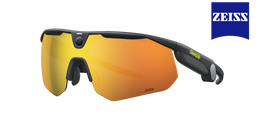
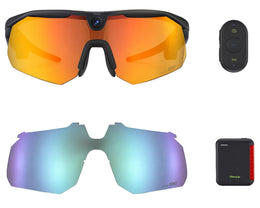
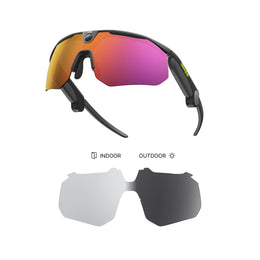
Point of view
Every mounted camera records where the bike is pointing. POV glasses record where you are looking, which is usually a different direction and almost always the more useful one — provided you understand what the position costs.
There is a reason so much action-camera footage looks the same. The camera is bolted to something rigid — a bar, a chest, a helmet — and it records that thing's axis rather than the rider's attention. When you turn your head to look at the gap you are aiming for, the mounted camera keeps filming straight ahead.
POV glasses invert that. The camera is on your face, so the frame follows your gaze. That sounds like a small change and it produces a categorically different kind of clip.

What eye-level actually changes
Three things change at once, and they are worth separating.
The frame follows attention. In practice, riders look where they are going a fraction before the bike goes there. A camera at eye level records that: the corner appears in frame just before you commit to it, the rider ahead is seen rather than imagined, the view you turned your head for is actually in the clip.
The horizon moves with you. A helmet mount holds a fixed pitch relative to the helmet; your head does not hold a fixed pitch relative to the horizon. On the drops your face points down, so a fixed-mount camera films the front wheel. On POV glasses the same problem exists, which is exactly why the tilt adjustment exists — you compensate by setting the brow module to minus ten or plus fifteen degrees depending on how you are positioned.
Height changes the composition. Eye level is roughly 1.5 to 1.6 metres. Handlebar height is roughly 0.9. A camera at bar height makes the road look wide and the world look low; at eye height, the road compresses into the distance the way you actually see it. This is the least discussed and most noticeable difference in the finished clip.
The three situations where POV wins
Group rides. A mounted camera records the road ahead. POV records what you are looking at, and in a group that is the rider half a wheel to your left, the wheel you are about to overlap, the gap closing at the next corner. It is the difference between footage of a route and footage of a ride.
Trails and technical terrain. Where you look is where you steer. A trail shot from eye level shows the line as you chose it, including the look-ahead that makes the line work. A bar-mounted camera shows the back of the next obstacle.
Anything where the interesting thing is beside the path. A view over a wall, a rider on the other side of a valley, a building you turned your head to see. A fixed camera misses it entirely; eye-level capture gets it because you turned to look.

The two situations where a mount still wins
Honesty is more useful than advocacy here.
Long, uninterrupted recording. A mounted action camera with a large battery and a full-size card can record a two-hour ride in continuous files. Camera glasses run about an hour of continuous recording, and at 3K60 the file limit is one minute per clip. If the assignment is "record the whole ride", a mount is the tool.
Maximum stability on very rough ground. A rigid mount, especially on the frame rather than the helmet, does not inherit your head's motion. Downhill mountain biking at speed produces head movement that no electronic stabiliser fully removes. If the footage has to be smooth above all else, the mount has the physical advantage.
What does not survive scrutiny is the idea that a mount is more convenient. It has to be aimed, checked after a knock, charged, and carried. POV glasses are on your face because your face is where you put them.
How the 120-degree field of view interacts with head movement
Field of view is the parameter that makes eye-level capture forgiving.
At 120 degrees, you no longer have to point your head precisely. Look roughly forward and the frame contains the road, the verge and a good slice of whatever you glanced at. That matters because you are not operating a camera, you are riding, and the moment you start composing shots is the moment your attention leaves the road.
The tradeoff is edge distortion. Wide lenses stretch the corners, and the further out you look in the frame the more curved things become. The 120-degree compromise is deliberate: wide enough that framing is nearly unnecessary, narrow enough that the edges do not look like a security camera.

Stabilisation is the enabling technology, not a bonus
A camera on a rigid mount inherits the bike's motion. A camera on your face inherits your neck's, which is worse.
That is why electronic image stabilisation matters more in this form factor than in any other. EIS crops and re-projects the frame based on detected motion, which costs you some field of view and requires spare pixels and frame-rate headroom to work. At sixty frames per second there is twice the temporal information to stabilise against; at thirty, the stabiliser has less to work with and the result is soft or juddery.
The practical consequence: when you compare POV glasses, compare the frame rate at the resolution you will actually shoot. A 3K60 mode and a 4K30 mode are not the same product, and for eye-level capture the first is usually the better one.
What POV footage is genuinely bad at
Two things.
Stable horizons. Your head tilts. Even with a level start, footage from a long ride will have a horizon that drifts. Some stabilisers correct roll; most do not fully. If you need a locked horizon, that is a gimbal, not glasses.
Your own body. A camera on your face does not show you. If the point of the clip is the rider in the landscape, POV is the wrong angle — you need a second camera, or a friend.
That second point is the honest limit of this category: POV glasses make excellent first-person documentation and mediocre self-portraits.
Choosing between POV glasses and a mount
A short decision path:
- Recording continuously for hours? A mount with a big battery.
- Recording moments and looking around? POV glasses.
- Need a locked horizon? Neither; a gimbal.
- Need the rider in frame? A second camera.
- Want one device you do not have to aim? POV glasses, and the 120-degree POV piece explains what that field of view does to framing.
The two are not actually in competition for most riders. The mount records the route; the glasses record the ride. If you already own an action camera, the mount versus camera glasses comparison covers how to decide which one comes on which ride, and the wider category comparison is in the recording glasses buying guide.
If you want to see the specification behind the numbers in this piece — the 120-degree field of view, the three-position tilt, the 3K60 recording modes — they are all listed on the BleeqUp Rover product page.
FAQ
What does POV mean for camera glasses?
Point of view: the camera is positioned at eye level so the footage shows roughly what the wearer sees. On BleeqUp Rover the camera sits in the brow, centred, level with the eye line, with a 120-degree field of view.
Is POV better than a helmet camera?
For footage that follows your attention, yes. For long continuous recording and maximum stability on very rough ground, a helmet or bar mount is still better. The two solve different problems rather than competing on the same one.
Why does POV footage look different from handlebar footage?
Height and pitch. Handlebar height is roughly 0.9 metres and points along the bike's axis; eye level is roughly 1.5 metres and points where you look. The road compresses differently and the horizon sits differently in the frame, which changes the sense of speed.
Can I adjust the camera angle on POV glasses?
On Rover, yes — the brow module tilts to minus ten degrees, level, or plus fifteen. This corrects for head position: on the drops you want to tilt down, walking or sitting upright you want level or slightly up. Ranger's camera is fixed.
Do POV glasses record what I am looking at behind me?
No. The field of view is about 120 degrees and centred forward. A glance over the shoulder will not capture the scene behind you, because the camera keeps pointing where your head points.
Is 120 degrees too wide?
It is a deliberate compromise. Wide enough that you do not have to aim, narrow enough that the edges do not distort badly. Narrower fields make framing a task you have to perform while riding; wider ones produce edges that look like surveillance footage.