Equestrian
Riding gives you three places to put a camera — the hat, the body, and the face — and only one of them requires modifying a piece of safety equipment that was certified without it.
Riders ask this question in a particular way, and the way they ask it gives away the answer. It is almost always *"where do I put the camera"* rather than *"which camera"* — because the hard part is not image quality, it is finding a surface that is stable, legal, and not a certified helmet.
So take the three positions in order. They are not equally good, and the ranking is not the one people expect.
Position one: the riding hat
The obvious place, and the most problematic.
The stability argument is weaker than it sounds. A helmet camera moves with the head, and a rider's head moves constantly: balancing, checking the reins, looking at the next fence, glancing down at the horse's shoulder. The footage is not unstable in the shake sense; it is unstable in the *what am I even looking at* sense. A camera pointed wherever the rider happened to glance produces a wandering frame.
The weight argument is real. Adding 100–150 g to the crown of a riding hat changes the balance point, and riders notice it in the first ten minutes. It is not dangerous, but it is noticeable, and noticeable things get taken off.
The rules argument is decisive. Many competition venues prohibit helmet-mounted cameras outright, and a number of national federations restrict them. More importantly, a helmet is certified as a unit. Adhesive mounts and strap systems are modifications to a piece of safety equipment that was tested without them, and some manufacturers state explicitly that attaching anything voids the certification position.
If your horse's hat came with a camera mount designed into it, that is a different conversation. If it did not, you are modifying certified equipment, and no amount of good intent changes what happens in an incident.
Position two: the body
Chest and shoulder mounts solve the helmet problem and introduce a new one: the horse.
A chest mount is anchored to a torso that pitches forward and back with every gait, and on a horse that movement is large — a rising trot is a vertical oscillation of maybe 15 cm twice a second. The result is footage that lurches in time with the gait.
It also points where your chest points, which is not where you are looking. On a hack that is acceptable. In an arena it means half the frame is the horse's neck.
Position three: the glasses
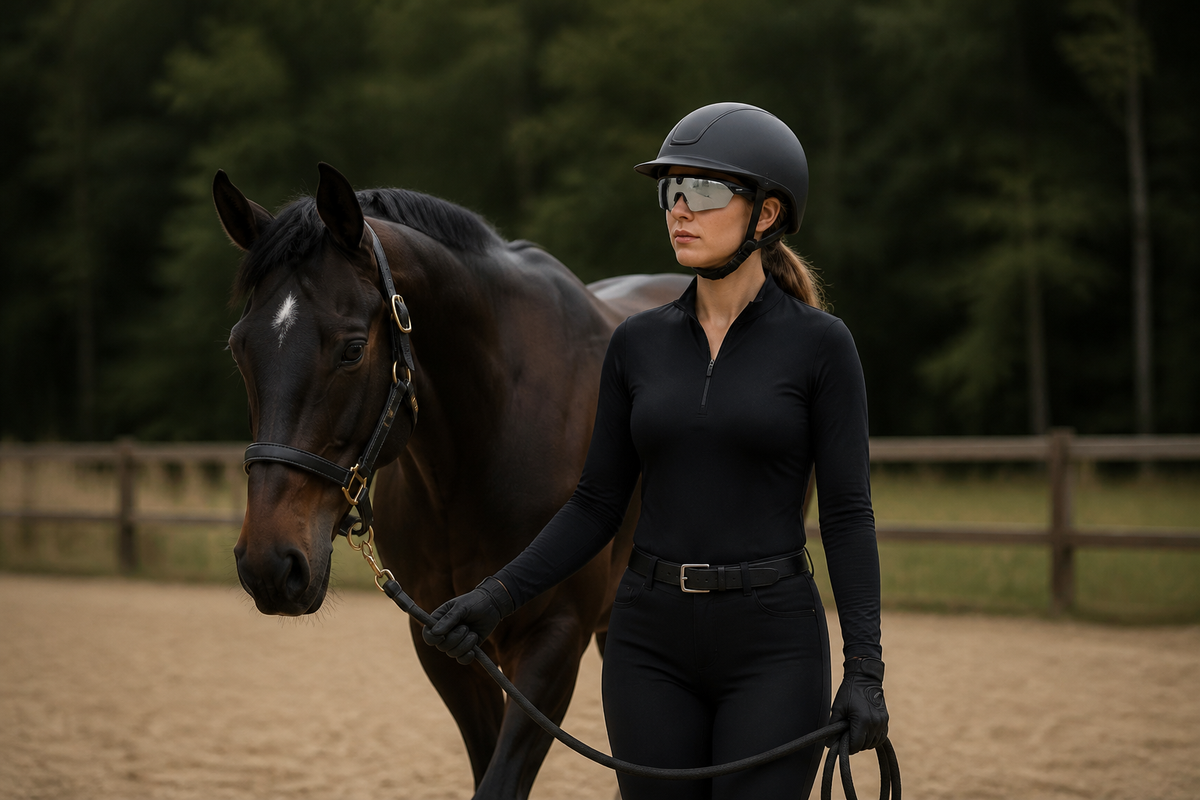
Camera glasses are the only option that adds nothing to the hat, adds nothing to the hand, and stays aligned with the head.
The framing is the argument. The between-the-ears view — the horse's ears at the bottom of frame, the track ahead, the fence line, the next turn — is a genuinely distinctive piece of footage. It is the only angle that shows both where you are going and the horse you are sitting on, and no other mount produces it.
Nothing is modified. The hat stays exactly as it was certified. That is not a small compliance point; it is the reason a lot of riders end up here after deciding a helmet mount was not worth the risk.
Both hands stay on the reins. This is the same argument as in every hands-busy sport, and it is even stronger in riding because the hand that is not on the reins is often the hand managing a lead rope, a whip or a gate.

What this hardware is, and what it is not
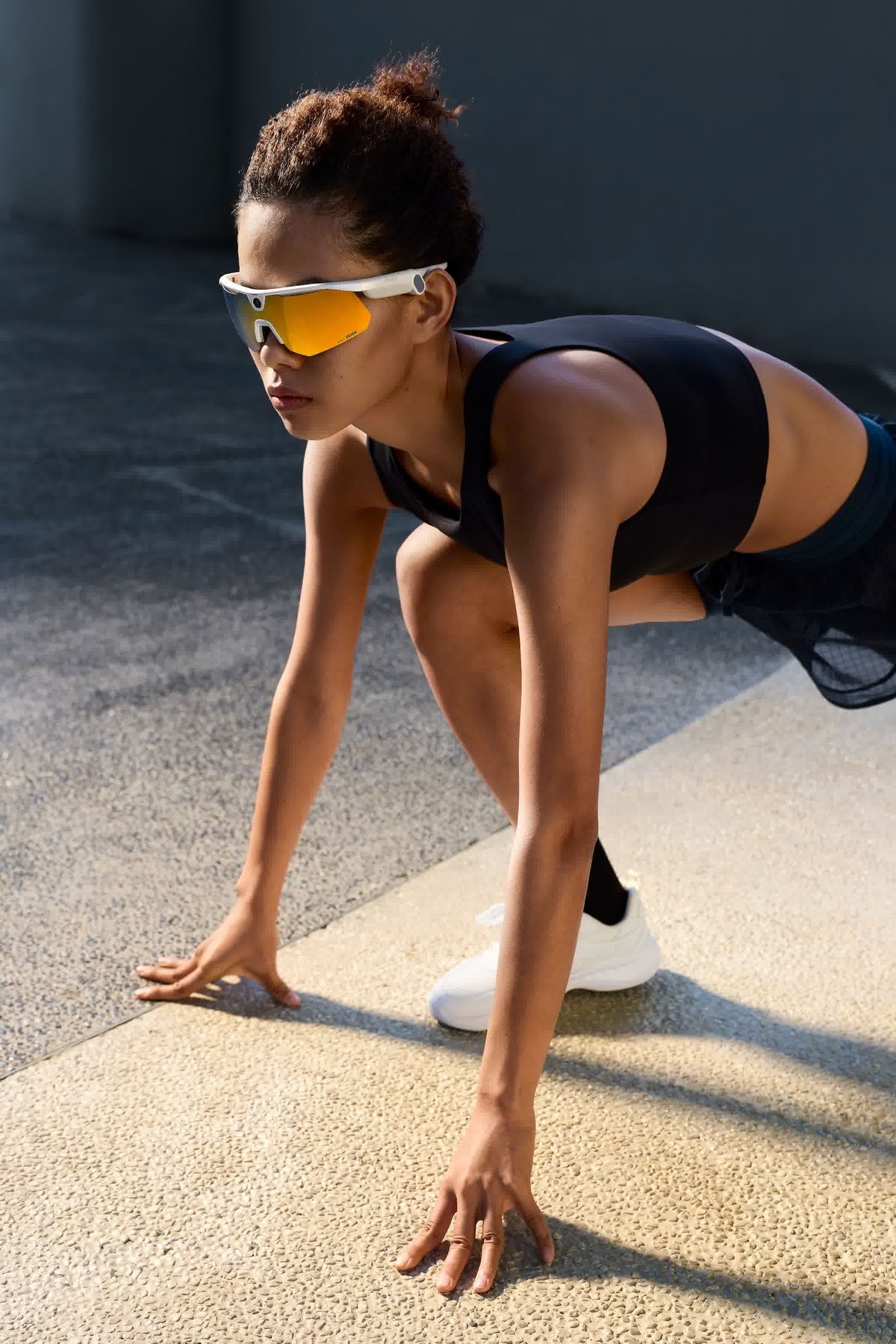
Rover is the same product used for cycling and running, in a different setting. It is not sold as equestrian-specific equipment, it carries no equestrian certification, and nobody should describe it as "designed for riders". What it is: a pair of glasses with a camera, an IP65 rating against dust and spray, and a frame that fits under a hat.
That honesty cuts both ways. It also means the limits are the general limits:
- About one hour of continuous recording, which is shorter than most riding sessions. Record in bursts — a schooling round, a course walk, a specific exercise — rather than the whole ride.
- IP65, not waterproof. Dust and spray are covered. A water jump, a hose-down, or a submerged stream crossing are not. Dry the frame out before charging.
- Arena dust is the practical enemy. Sand schools generate fine dust that settles on the front element and degrades footage quietly. A microfibre cloth in the tack box is worth more than any setting.
- Heat. An hour of recording in summer sun is the practical ceiling for a battery this size.

The same glasses-based approach is covered in more depth in camera glasses for horse riding, and if you are working out what to actually film in a schooling session, how to record horse riding POV video is the practical companion.
The rules decide more than the hardware
Before comparing mounts, check what your venue allows. Competition rules on personal recording vary by discipline and by country, and they usually cover three things: whether recording is permitted at all, whether footage may be published, and whether equipment may be attached to the rider or the horse.
This is not a footnote. In several disciplines the answer to "can I film this" is *yes for personal use, no for publication*, and the distinction lives in the schedule rather than the rulebook. Our piece on recording rules for equestrian competitions works through what to ask and who to ask.
The other thing that decides the question: other people's horses. Warm-up rings, shared arenas and livery yards are full of animals belonging to people who did not agree to be filmed, and a horse reacting to a camera is a genuine safety event.
A pragmatic setup for a schooling session
1. Fit before you tack up. Nose pads first, then temple arms. The frame has to stay put through a rising trot, and a fit that works standing still is not the same fit. 2. Choose the mode deliberately. 1080p30 has no per-clip limit; 3K30 lets you pick 1, 3 or 5 minutes; 1080p60 and 3K60 are fixed at one minute. A dressage test or a course round fits comfortably in 3K30 at three minutes. 3. Record the exercise, not the session. Ten minutes of arena footage is mostly walking on a long rein. 4. Review the same day. The value is in seeing what you did not feel — the horse falling in through a shoulder, a late aid, a line you thought was straight. 5. Check where the footage may go before you post it. That is a rules question, not an editing one.
Full specifications, including the IP65 rating and the 3K60 HDR modes, are on the BleeqUp Rover product page.
FAQ
Can I attach a camera to my riding hat?
Many riders should not. A helmet is certified as a complete unit, and adhesive or strap mounts are modifications to safety equipment that was tested without them. Several manufacturers state that attaching anything affects the certification position, and many competition venues prohibit helmet-mounted cameras outright. Check the hat's manufacturer guidance and the venue rules first.
Is a helmet camera or camera glasses better for riding footage?
For most riders, glasses. The helmet position moves with every glance and adds weight to the crown, and it modifies certified equipment. Glasses keep the hat untouched, keep both hands on the reins, and produce the between-the-ears framing that a helmet camera cannot.
Do camera glasses work with a riding hat?
They fit under a standard hat if there is clearance above the temple, and the combination should be tried before you buy. A very close-fitting hat can press on the temple arm; that shows up after ten minutes, not immediately.
Can I film a competition?
Sometimes, and usually only for personal use. Recording rules vary by discipline, venue and country, and they commonly distinguish between filming for yourself and publishing the footage. Ask the organiser before the day rather than assuming it is allowed.
How long can I record in one session?
About one hour of continuous recording on the internal battery, which is shorter than most riding sessions. Record in bursts — one test, one course, one exercise — and keep the rest of the session for riding.