Flag Football
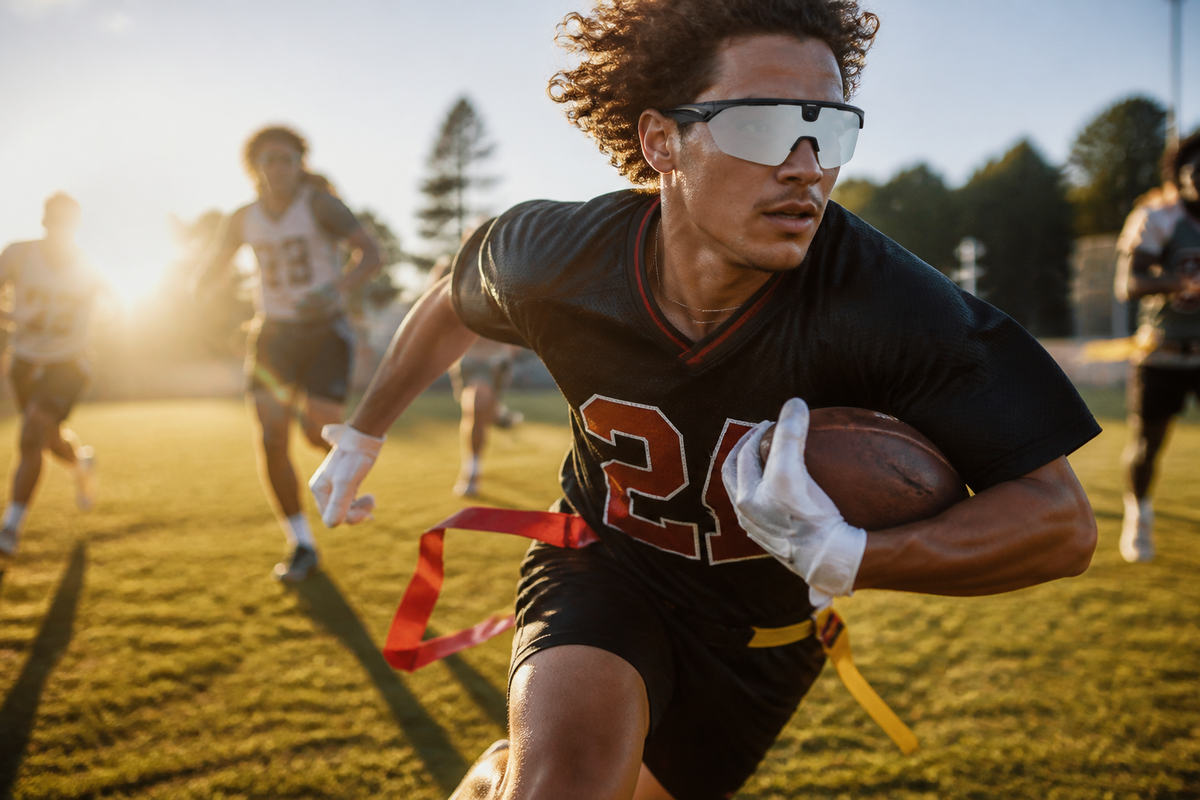
Flag football is the rare team sport with no helmet to bolt a camera to and no free hand to hold one — which makes the face the only mount point that was there all along.
In helmeted sports the camera question has an obvious answer: bolt it to the helmet. In flag football there is no helmet, so the question reopens, and the answers people reach for first are the worst ones.
A chest strap bounces at exactly the frequency of a running stride, which is to say it produces footage you cannot watch. A handheld gimbal lasts about one play before you need both arms. A camera on a fence or a tripod records the field from one fixed point, which is fine for a highlight reel and useless for anything else.
Glasses solve the problem by removing the decision. There is no mounting step, no strap to tighten, and no hand occupied — and in a sport where your hands are either catching, carrying or reaching for a flag, that is not a small detail.
What eye-level footage shows that a sideline camera cannot
A fixed camera at the sideline sees the play as a spectator does: everything at once, all of it small. Eye-level footage sees it as the player does, which means it is good at a completely different set of questions.
Pursuit angles. When you missed a flag, the useful review question is not "was I slow" but "what angle did I take". From the eyes, that angle is the frame centre. You can see whether you overran the ball carrier or got caught flat-footed on the cut.
Spacing before the snap. Receiver splits, linebacker depth, whether the defence is crowding the short side. This is the pre-snap read a player is actually making, and the only camera that has it is the one between the ears.
Flag reach and hand placement. The flags hang at hip height, which is the bottom edge of a downward-looking frame. Whether you reached *for* the flag or *at* the carrier's body is visible in a way it never is from the sideline.
What it does not show is everything happening across the field: the safety coming over, the receiver breaking open on the far side, the official's flag on the ground. Flag football is a spacing sport, and a first-person view narrows spacing to the two or three yards in front of you.

No helmet also means no protection
Here is the part that does not get said often enough: a pair of camera glasses is eyewear, not protective equipment.
Rover's impact rating is ANSI Z80.3, which is the standard for everyday non-prescription dress eyewear. It is not ANSI Z87.1, the industrial eye-protection standard, and it is not a sport-impact certification of any kind. If you are playing a contact sport and you want eye protection, buy actual sport eye protection; do not treat a camera pair of glasses as a substitute.
That matters in flag football specifically because blocking and contested catches bring fingers, elbows and occasionally a shoulder toward the face. The glasses will survive ordinary handling. They are not designed to be tested.
The running load is the real constraint on a game day
Flag football is stop-start, which is good news for a battery, and sprint-heavy, which is bad news for anything mounted loosely.
Battery. Rover records about one hour continuously. A full game runs longer than that, so the working pattern is the same as in any stop-start sport: on for the series you care about, off between. A 260mAh cell is not going to cover 90 minutes of continuous play, and no compact wearable will.
Heat and continuous use. An hour in warm autumn sun is the practical ceiling. Shade breaks are free.
Clip limits. 1080p30 has no time limit per clip; 3K30 lets you choose 1, 3 or 5 minutes; 1080p60 and 3K60 are fixed at one minute. A play lasts a few seconds, so the limit rarely bites — but a huddle-to-huddle recording will hit the one-minute cap in a 60fps mode, and you will lose the snap without noticing.
Stabilisation. Multi-axis electronic stabilisation is doing real work here. A sprinting head is a badly shaken platform, and EIS is the difference between footage you review and footage you delete.

Fitting it so it survives a play
Three things, in order of how often they go wrong:
1. Nose pads. Rover's are three-axis adjustable. Most glasses fit problems are really nose-pad height problems, and half a millimetre of lift is the difference between the frame staying put and sliding down a sweaty nose on the second sprint. 2. Temple arm tension. The arm has to sit against the skull, not on the ear. If it is resting on the ear, it will lift on every cut. 3. Both of the above, before you start moving. A pair that fits while standing still can still be wrong at speed. Simulate a sprint in the first five minutes rather than discovering it in the second quarter.
If you wear a light cap or a headband, the arm has to go under it, not over it. Over it, the frame tilts forward and the camera records the ground twenty yards ahead.
Filming a shared field: consent is the rule, not the disclaimer
Stacked leagues and pickup games mean the field is full of people who did not agree to be filmed. League rules vary widely — some organisations prohibit recording without written permission from every participant, and youth leagues are stricter.
Ask the league, ask both captains, and expect some teams to decline. A camera that looks like a pair of sunglasses is also harder for other people to notice than a helmet camera, which arguably raises the obligation to tell them rather than lowering it.
Choosing between this and the alternatives
The realistic alternatives are a chest-mounted action camera and a fixed sideline camera. The sideline camera wins on field overview and loses on everything a player cares about. The chest mount wins on framing stability and loses on bounce and comfort in a sport that is mostly running.
For the field-wide comparison across sports, see camera glasses for outdoor sports. Baseball has the same hands-are-busy problem with a completely different geometry — baseball camera glasses covers that side of it.
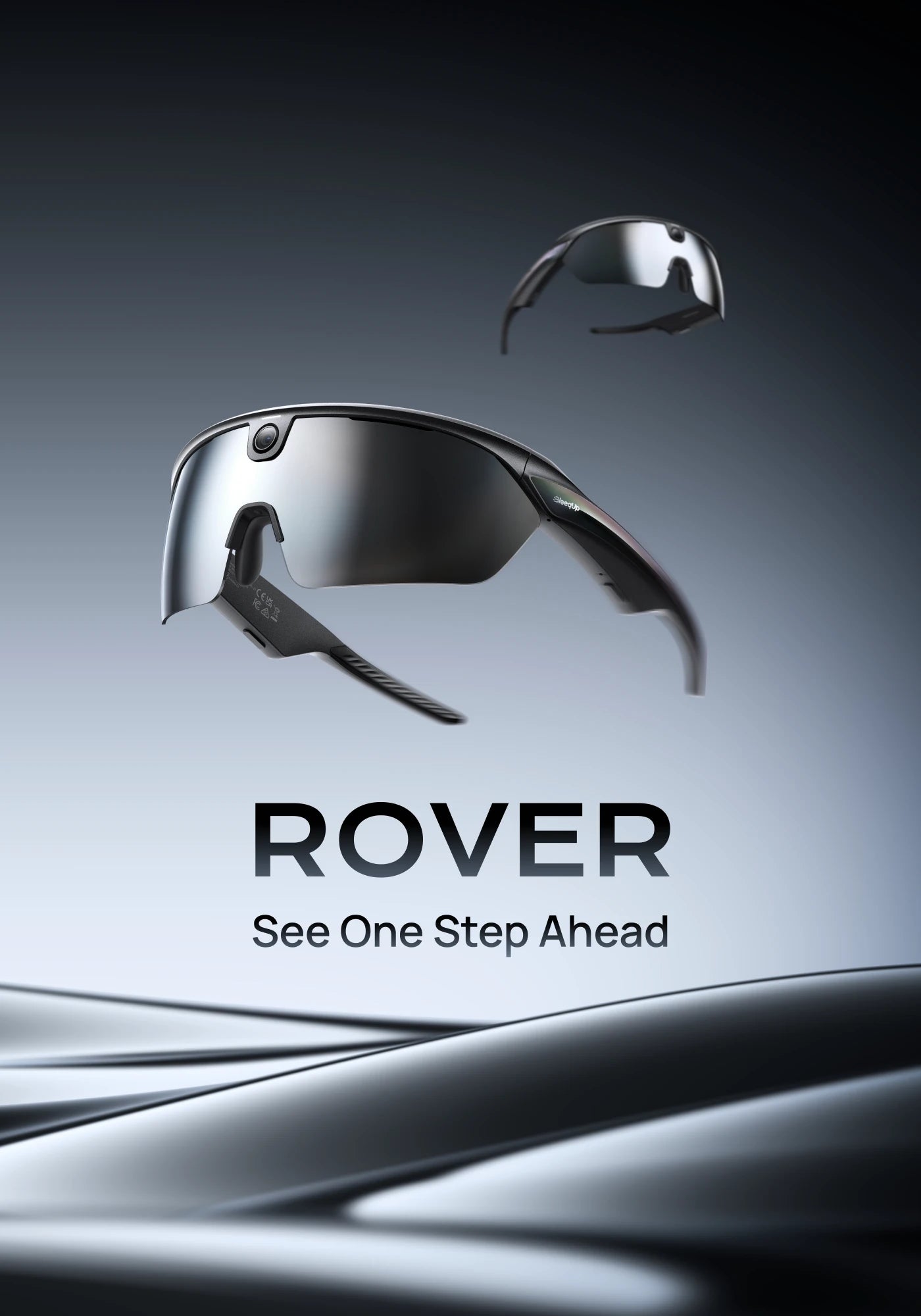
Specifications for Rover, including the IP65 rating, the 120° field of view and both storage options, are on the BleeqUp Rover product page.
FAQ
Do you need a helmet to use camera glasses for flag football?
No — that is the advantage. There is nothing to mount and nothing to bolt on. The glasses are the mount. The only requirement is a fit that survives a sprint, which is a nose-pad and temple-arm question rather than a helmet question.
Will they stay on during a sprint or a dive?
A correctly fitted pair stays put through sprinting and cutting. Diving is a judgement call: the frame will survive ordinary contact, but it is eyewear rather than protective equipment and it is not designed to be landed on. Take it off if the drill involves going to ground.
Are camera glasses safe to play in?
They carry an ANSI Z80.3 everyday impact rating, which is not the same as ANSI Z87.1 industrial protection and is not a sport-impact certification. If you want eye protection for a contact sport, buy sport eye protection. Use camera glasses for filming.
How much of a game can I record?
About one hour of continuous recording on the internal battery. Games are longer, so record the series you care about rather than the whole game. 1080p30 has no per-clip time limit; the 60fps modes are capped at one minute per clip.
Can I record someone else's team?
Only with permission. League rules on recording vary and are usually stricter at youth level. Ask the league and both captains before filming anyone who is not on your own team.