
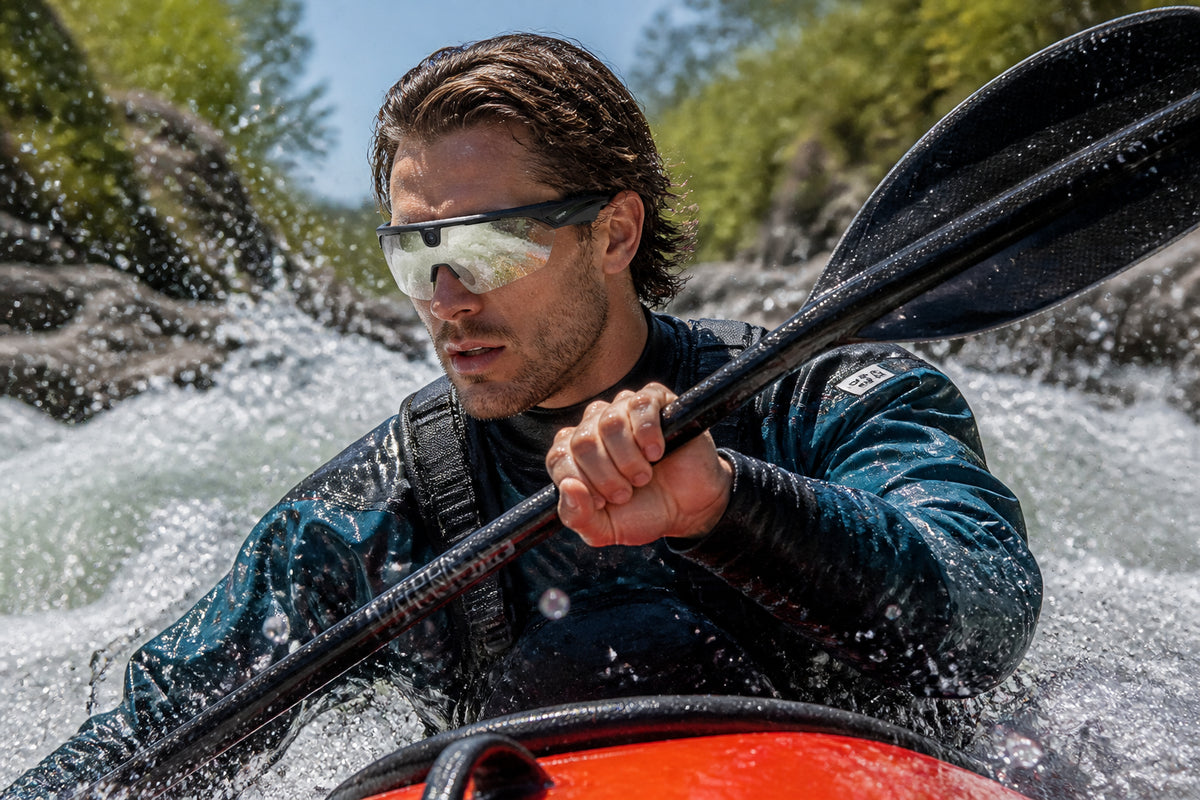
On the water
Water is the harshest environment in this guide, and it exposes the difference between a rating on a spec sheet and a paddle in your hand. Before choosing between a mount and a pair of glasses, it is worth knowing which of the two actually survives a day on the water.
Paddling is the activity where camera eyewear is most likely to be ruined and least likely to be chosen deliberately. People take the glasses they use on the bike, wear them on a lake, and discover three things in sequence: that spray gets everywhere, that the frame does not float, and that the footage is mostly water on the lens.
None of that makes the product wrong for water. It makes the expectation wrong. This piece is about setting it correctly.

What IP65 actually covers
The two digits do different jobs.
6 — dust-tight. No ingress of dust at all. For paddling, that is mostly irrelevant; for a beach launch with sand in the air and on your hands, it is not.
5 — protected against water jets. Low-pressure jets from any angle, which is roughly what a paddle stroke throws at your face and considerably less than what a wave delivers.

What it does not cover: immersion. IP65 is not IP67 or IP68. A pair of glasses that goes into the lake and stays there is out of specification the moment it goes under, and there is no warranty conversation that goes well after that.
That single distinction changes how you should carry them. On a bike, the risk is rain. On water, the risk is a capsize, and a capsize puts things on the bottom of a lake.
Spray is harder on a worn camera than on a mounted one
Three reasons, and they are specific to the position.
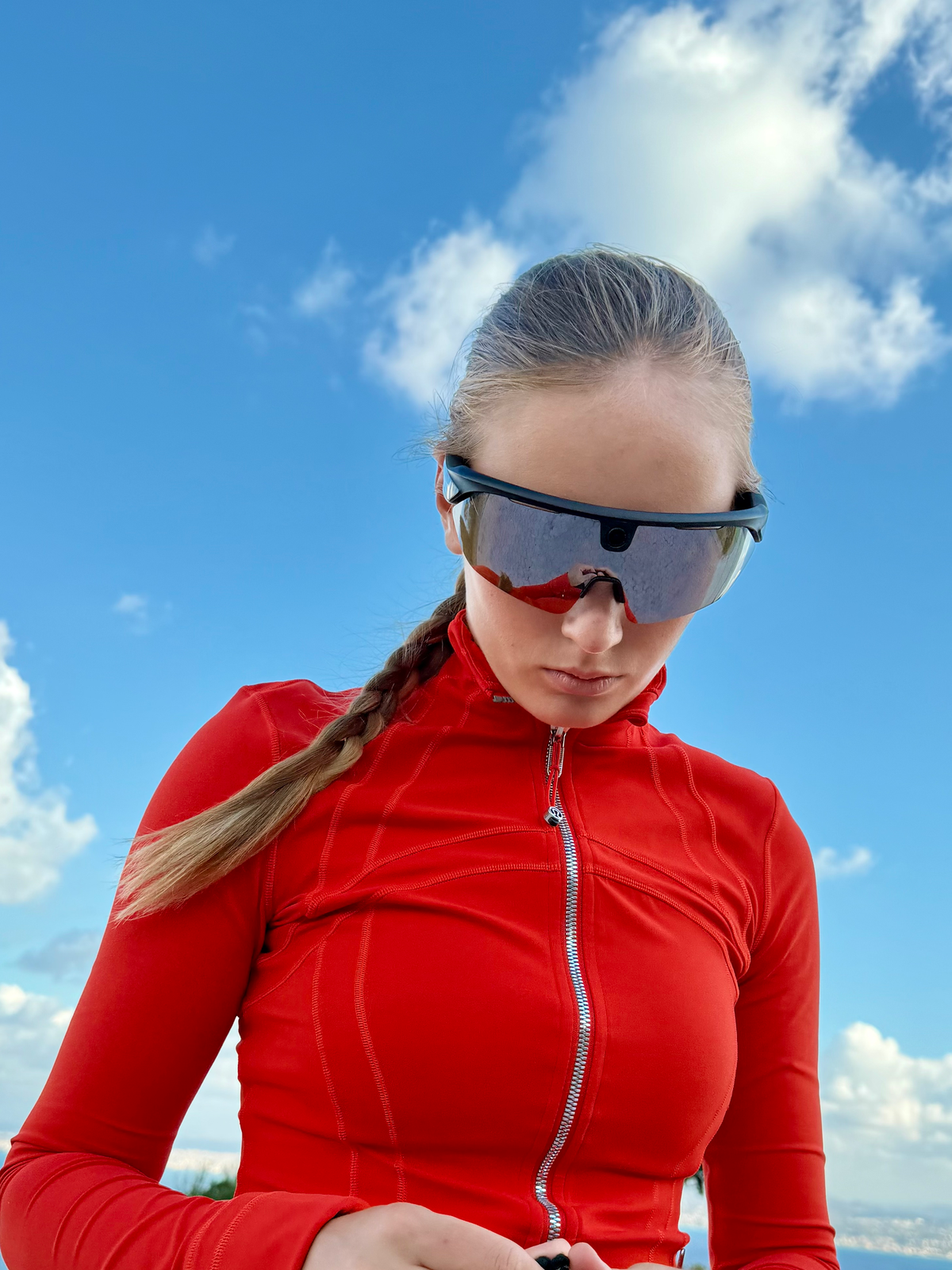
The lens faces the water. A camera mounted on a deck faces forward and gets the occasional splash. A camera on your face is at the exact height where a paddle stroke throws a sheet of water, and the lens is the first thing it hits. Water on the lens is not a hazard to the hardware; it is a hazard to the footage, and it produces clips that are half usable and half blur.
Your head moves a lot. Paddling involves torso rotation and a head that turns to look at the shoreline. A camera on your face inherits all of that, plus the boat's motion, which is why stabilisation matters even more here than on a bike.
Getting it off in a hurry is awkward. On a bike you can stop. In a kayak, your hands are holding a paddle and the thing you want to do — take the glasses off — requires both of them.
None of that is disqualifying. It does mean that on water, more than anywhere else, the practical question is not "which camera is better" but "which camera will I actually keep clean and dry".
The buoyancy problem nobody plans for
Camera glasses do not float. Neither do most compact action cameras, which is why the accessory market for flotation straps exists.
If you are paddling, the risk management is unglamorous and effective:
- A retaining strap, so a fumbled removal does not end at the bottom.
- A hard case in the boat, so the glasses live somewhere other than your face when you are not filming.
- A float on anything you clip to the boat.
- A dry bag for the phone, because the transfer step is where a wet day becomes a lost day.
Weight is the trade: 53g on the face is fine, and 53g plus a strap plus a case is the actual kit weight.
Kayak and paddleboard are different problems
They share water and nothing else.
Kayaking is a seated, low position. Your eye height is perhaps a metre above the surface, which is close to the water and means spray arrives at a shallow angle and stays on the lens. Your hands are occupied at all times. The boat is narrow, so the camera has a clear forward view but very little lateral freedom — which is an argument for eye-level capture, because turning your head is the only way to see the bank.
Paddleboarding is a standing position, roughly 1.8 metres above the water, on a stable platform in flat water and an unstable one in chop. The higher position gives a much better view of the water ahead and the shoreline, and it makes eye-level footage genuinely pleasant — a standing eye line over a lake is a composition you cannot get from a deck mount. The cost is balance: turning your head to look at something is a bigger deal standing on a board than sitting in a boat.
Whitewater is a third case and deserves its own warning. Immersion is not a risk there, it is a certainty. Camera glasses are not the right equipment for whitewater; sealed action cameras are.

Mount or glasses: the decision
A short path, because the decision is genuinely simple once the risk is clear.
Choose a deck mount if you are paddling whitewater, if the camera must run for hours, or if you want footage that includes the paddler. A mount is rigid, aimable and replaceable; it also survives immersion if you buy the right housing.
Choose camera glasses if you are paddling flat water, if the interesting thing is the view rather than the boat, and if you want to record in short opportunistic bursts. The glasses are already on your face, which is the entire advantage, and eye-level footage over water is a composition worth having.
The honest overlap: most people who paddle regularly own both, and use the mount for a planned trip and the glasses for everything else. Camera glasses for outdoor sports covers the multi-sport case, and the rain piece covers the wet-weather half of the same problem.
Practical kit for a day on the water
- A retaining strap on the glasses, always.
- A microfibre cloth in a pocket, not in the boat bag — you will need it mid-stroke.
- A hard case for the glasses, in the boat.
- A dry bag for the phone you will transfer to.
- 1080p30 or 3K30 as the recording mode, not 3K60: fewer, longer clips and less heat.
- A hat with a brim if it is sunny, because a screen you cannot see in glare is a screen you cannot frame with.
One setting worth changing on water: drop to 1080p30. It has no clip limit on this hardware, so a long flat-water paddle records as a single file rather than sixty one-minute pieces, and the lower bitrate means less heat in a frame that is sitting in the sun.
What the footage is actually good for
Be honest about the genre.
Water footage from camera glasses is rarely cinematic. It is documentation: the route you took, the conditions, the wildlife you saw, the state of the launch. That is a modest ambition and it delivers — a standing eye line over a lake records the lake the way you saw it, and no deck mount reproduces that.
What it will not deliver is a polished paddling film. That needs a housing, a mount, a second angle and a person willing to stop paddling.
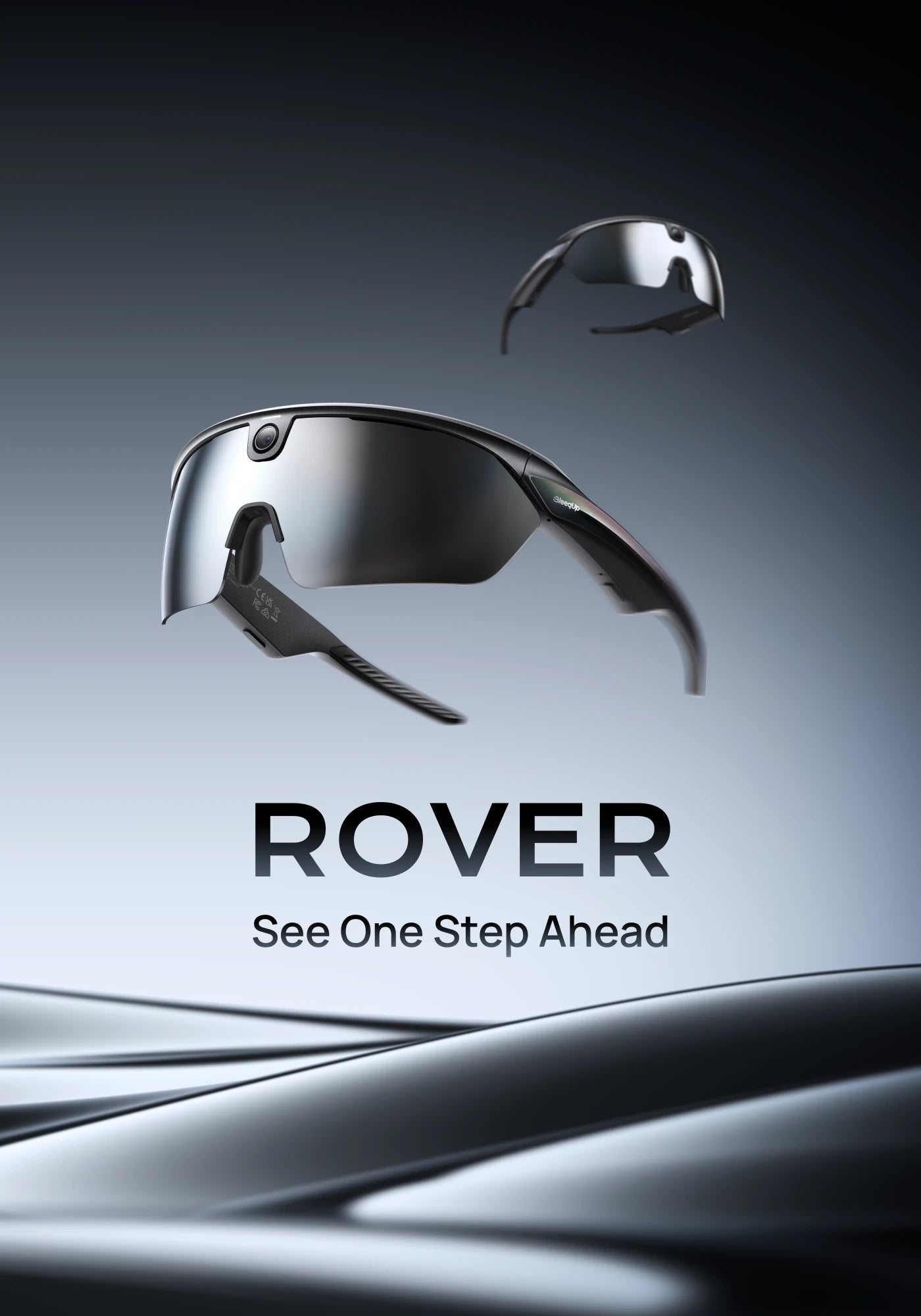
If you are comparing this use against cycling, the numbers are the same — an hour of recording, a 120-degree field of view, 3K60 with HDR — and the Rover review is where the compromises are listed without a sales gloss. The product page carries the IP65 statement and the storage options.
FAQ
Are camera glasses waterproof enough for kayaking?
IP65 covers dust and low-pressure water jets from any angle, which is fine for spray and rain. It does not cover immersion, so a capsize that submerges the glasses takes them out of specification. For whitewater or any paddling where the glasses will go under, use a sealed action camera in a housing instead.
Do camera glasses float?
No. Neither do most compact cameras. Use a retaining strap and keep the glasses in a hard case when they are not on your face. A float accessory is cheap insurance if you paddle on deep water.
What is the best camera setting for paddling?
1080p30 is the most practical on water: it has no clip limit on this hardware, produces less heat, and the lower bitrate means longer recording per gigabyte. 3K60 is better for a short planned shot, but records in one-minute clips.
Can you see through the lens when it is wet?
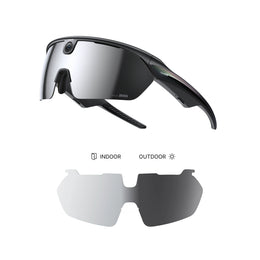
Partly. Water on a shield lens breaks up the view and shows in the footage. A microfibre cloth within reach is part of the kit, and the first few seconds of any clip after a splash will be blurred. A coated shield sheds water better than an uncoated one, but nothing makes a wet lens invisible.
Is eye-level footage useful on a paddleboard?
Yes, and it is the strongest case for the form factor on water. Standing eye height over flat water gives a composition a deck mount cannot reach, and short clips of the view are what most paddlers actually want.
Can you wear them under a helmet?
For kayaking, a helmet and glasses can coexist if the temple arms fit under or outside the helmet's straps rather than being pinched by them. Try the combination before you are on the water, because adjusting glasses with both hands on a paddle is not practical.